
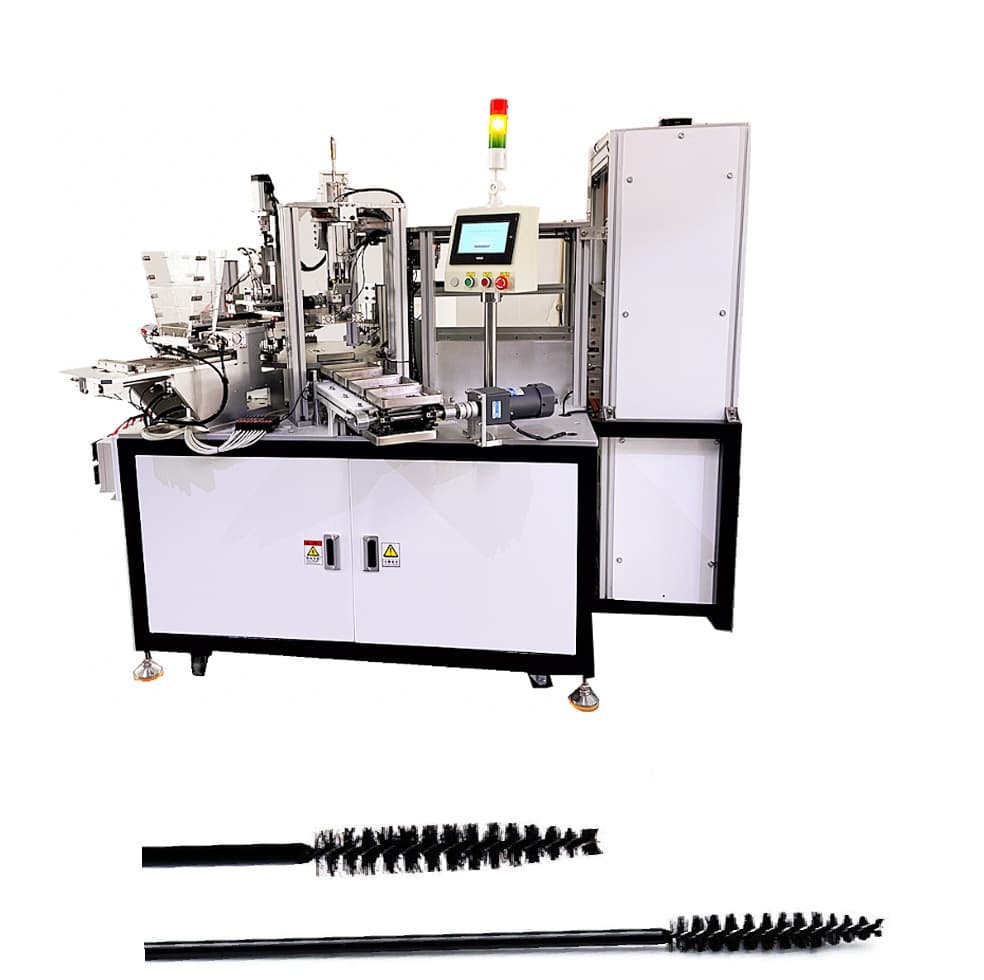
10-Piece Fully Automatic Eyelash Brush Assembly Machine
Product Overview
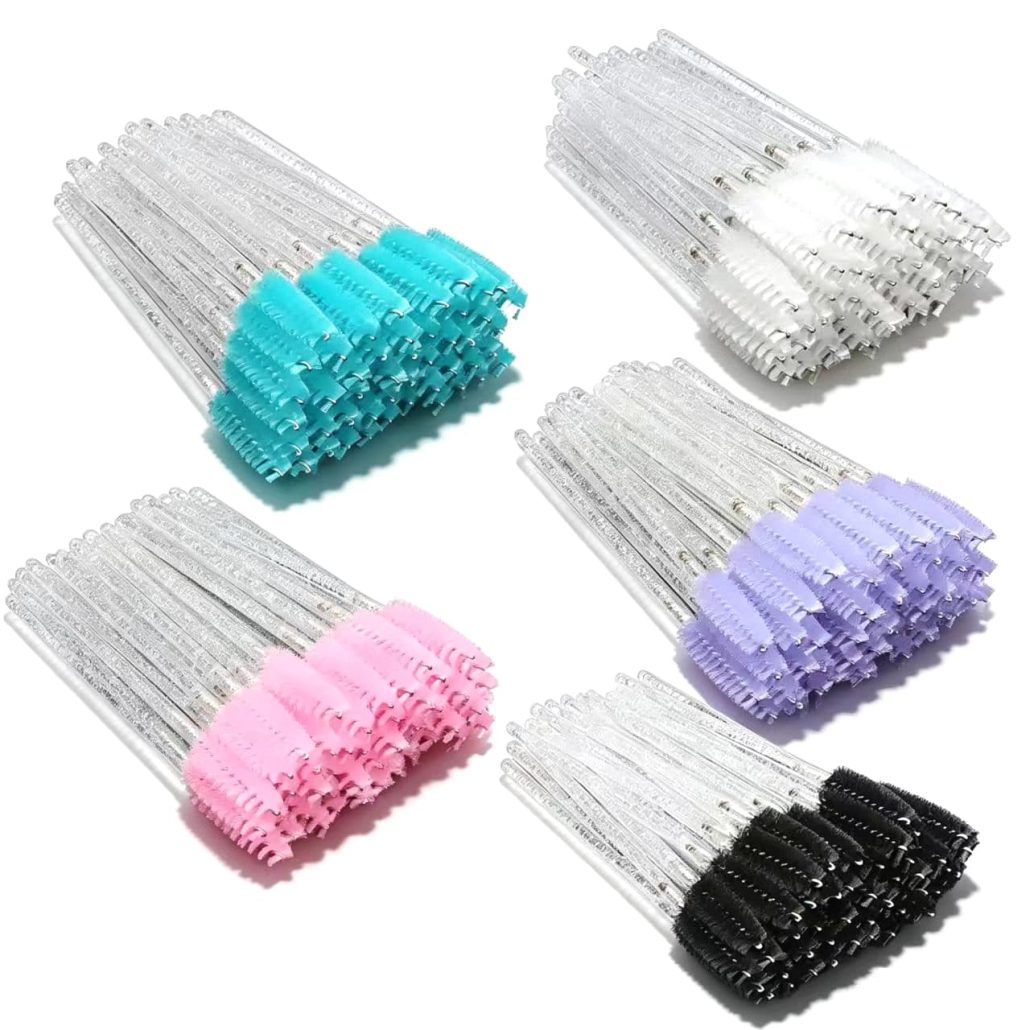
The Eyelash Brush Assembly Machine is designed for assembling brush heads with plastic handles used in mascara brushes, eyelash brushes, cosmetic applicators, eyebrow brushes, and other beauty-care products.
According to the required production capacity, eyelash brush assembly equipment can generally be divided into two categories:
- Single-piece semi-automatic assembly machine
- Multi-piece fully automatic assembly machine
The multi-piece model can be designed to assemble 2, 4, 5, 8, or 10 brushes per cycle. This product page mainly introduces our 10-piece fully automatic Eyelash Brush Assembly Machine, which can assemble ten brush heads and ten handles simultaneously.
The machine must work together with a Brush Head Tray Loading Machine. The tray loading machine first arranges loose and randomly oriented brush heads into a plate in the correct direction and sequence. The assembly machine then picks up one complete row of brush heads from the plate and completes automatic handle feeding, heating, insertion, assembly, and finished-product discharge.
This Mascara Brush Assembly Machine has a production capacity of up to 8,000 pieces per hour, making it suitable for cosmetic brush manufacturers requiring stable, continuous, and high-volume production.
Difference Between Single-Piece and Multi-Piece Assembly Machines
Single-Piece Assembly Machine
The single-piece Cosmetic Brush Assembly Machine is a semi-automatic machine.
An operator manually places or inserts one brush head into the loading position. The machine then assembles one brush head with one handle during each cycle.
This model is suitable for:
- Small production quantities
- Product testing
- New product development
- Factories with lower automation requirements
- Customers with limited initial investment
- Products that change frequently
Because one operator must continuously load the products, the single-piece machine still depends on manual labor.
Multi-Piece Assembly Machine
The multi-piece Makeup Brush Assembly Machine is a fully automatic system.
It can be designed for:
- 2 pieces per cycle
- 4 pieces per cycle
- 5 pieces per cycle
- 8 pieces per cycle
- 10 pieces per cycle
The number of brush heads arranged in each row of the plate must match the number assembled during each cycle.
For example:
- A 10-piece assembly machine requires 10 brush heads in each plate row.
- A 5-piece assembly machine requires 5 brush heads in each plate row.
- An 8-piece assembly machine requires 8 brush heads in each plate row.
The plate layout, gripper quantity, handle-feeding track, assembly fixture, and output system must therefore be designed as one coordinated production system.
The 10-piece Beauty Brush Assembly Machine described here is a fully automatic solution developed for customers requiring higher production capacity and reduced labor dependence.
Brush Head Tray Loading Machine
Before entering the assembly process, loose brush heads must be arranged in the correct direction and order.
Brush heads are normally supplied in a mixed and disorganized condition. Because they are lightweight, flexible, and difficult to orient consistently, they cannot always be fed directly into a multi-piece assembly station.
The Brush Head Tray Loading Machine solves this problem by automatically arranging the brush heads into customized plates.
Its main functions include:
- Receiving loose brush heads
- Identifying or controlling brush-head orientation
- Arranging the brush heads in a fixed direction
- Placing them into the plate one by one
- Maintaining equal spacing between products
- Creating complete rows for robotic pick-up
For the 10-piece Mascara Wand Assembly Machine, each plate row contains ten brush heads. The spacing between the brush heads corresponds exactly to the spacing of the ten-position robotic gripper.
This design allows the assembly machine to pick up ten brush heads simultaneously without requiring manual sorting.
Working Process of the 10-Piece Assembly Machine
Step 1: Brush Heads Are Arranged in the Plate
The Brush Head Tray Loading Machine places the loose brush heads into the plate according to a fixed direction and sequence.
Each plate is customized according to:
- Brush-head length
- Brush diameter
- Metal-rod diameter
- Brush-head shape
- Product spacing
- Gripper dimensions
- Number of products assembled per cycle
For this machine, the plate contains ten brush heads in each row.
Step 2: Ten Brush Heads Are Picked Up
The robotic gripper moves to the plate-loading position and picks up ten brush heads at the same time.
The gripper must hold all ten products securely without damaging the fibers, deforming the brush heads, or changing their orientation.
Customized gripper fingers are designed according to the customer’s product samples.
The gripper then transfers the ten brush heads to the central assembly station.
Step 3: Automatic Handle Feeding
Plastic handles are loaded into a vibratory bowl feeder.
The vibratory bowl automatically:
- Sorts the handles
- Controls their direction
- Separates overlapping parts
- Transfers them through the linear feeding track
- Supplies ten handles to the central assembly station
Sensors monitor the presence of each handle. The machine only begins the assembly cycle after confirming that all required brush heads and handles are correctly positioned.
Step 4: Handle Positioning
Ten handles are placed into the customized fixture at the central workstation.
The fixture controls:
- Handle spacing
- Handle direction
- Handle height
- Assembly position
- Product stability
The center-to-center distance between the handles corresponds to the spacing of the ten brush heads in the plate and robotic gripper.
This coordinated design helps ensure that all ten products can be assembled simultaneously.
Step 5: Controlled Flame Heating
Before insertion, the upper end of each plastic handle is heated by a controlled flame-heating system.
The purpose of this process is to soften or slightly melt the handle’s insertion area so that it can be fitted smoothly and securely onto the brush-head rod.
The heating process helps solve several common assembly problems, including:
- Excessive insertion resistance
- Handle cracking
- Brush-head rod bending
- Incomplete insertion
- Uneven insertion depth
- Loose connection after assembly
- Damage caused by excessive pressing force
Important heating parameters can be adjusted according to the plastic material and product structure, including:
- Flame position
- Heating distance
- Heating time
- Heating intensity
- Handle rotation, when required
- Delay before insertion
The heating system must be carefully adjusted to soften the handle without causing excessive melting, burning, discoloration, or deformation.
Step 6: Ten Brush Heads Are Assembled
After heating, the robotic system accurately aligns the ten brush-head rods with the ten softened handle openings.
The machine then completes the insertion and assembly process.
The assembly station controls:
- Insertion direction
- Insertion depth
- Insertion speed
- Pressing force
- Holding time
- Product alignment
All ten brushes are assembled during the same machine cycle.
This synchronized assembly method provides much higher efficiency than single-piece or manual assembly.
Step 7: Cooling and Position Stabilization
After insertion, the assembled products may remain in the fixture briefly to allow the heated plastic to cool and stabilize.
This helps ensure a firm connection between the brush head and the handle.
The cooling or holding time can be adjusted according to:
- Handle material
- Heating temperature
- Insertion depth
- Product dimensions
- Required connection strength
Step 8: Finished-Product Transfer
After assembly is completed, the robotic arm picks up the ten finished eyelash or mascara brushes.
The products are transferred to the output station.
The output system can be customized as:
- Conveyor output
- Collection tray
- Finished-product box
- Plate collection
- Connection with inspection equipment
- Connection with packaging equipment
Production Capacity
The production capacity of the 10-piece Eyelash Brush Assembly Machine is approximately:
8,000 pieces per hour
Actual production speed depends on several factors:
- Brush-head structure
- Handle material
- Required heating time
- Insertion depth
- Product dimensions
- Feeding stability
- Plate replacement time
- Inspection requirements
- Output method
Because ten products are processed simultaneously, the machine provides substantially higher output than a single-piece semi-automatic machine.
This machine is particularly suitable for factories producing large quantities of standardized mascara brushes or cosmetic applicators.
Main Machine Features
Ten-Piece Simultaneous Assembly
The machine picks up, heats, inserts, assembles, and discharges ten products during one cycle.
This multi-piece working method significantly improves production efficiency.
Fully Automatic Operation
The fully automatic production process includes:
- Brush-head plate feeding
- Ten-piece robotic pick-up
- Handle vibratory feeding
- Handle positioning
- Flame heating
- Brush-head insertion
- Assembly
- Finished-product transfer
- Output
Only limited operator involvement is required for material replenishment, plate loading, routine inspection, and machine monitoring.
Customized Plate Design
The plate is customized according to the number of products assembled per cycle.
For a ten-piece machine, each row contains ten brush heads. This ensures accurate alignment with the robotic gripper and assembly fixture.
Stable Handle Feeding
The vibratory bowl feeder automatically sorts and supplies the plastic handles. Sensors confirm whether all ten handles have reached the assembly station.
Controlled Heating Process
The flame-heating system softens the handle opening before insertion, helping reduce assembly force and improve connection stability.
Accurate Robotic Handling
The robotic gripper picks up ten brush heads together and maintains their position throughout the transfer and assembly process.
Adjustable Process Parameters
The operator can adjust important settings through the machine control system, including:
- Feeding speed
- Robotic position
- Heating time
- Insertion depth
- Assembly speed
- Holding time
- Output timing
Customized Tooling
The plate, gripper, handle fixture, heating device, insertion tooling, and output station can all be customized according to the customer’s products.
Control System
The machine uses a XINJE PLC control system.
The PLC controls the complete production process, including:
- Brush-head pick-up
- Handle feeding
- Sensor confirmation
- Robotic transfer
- Flame-heating timing
- Assembly motion
- Product discharge
- Production counting
- Alarm handling
The control system provides a stable operating sequence and allows different parameters to be adjusted according to the product model.
Pneumatic System
The machine uses AirTAC pneumatic components from Taiwan.
The pneumatic system controls various machine movements, such as:
- Product clamping
- Fixture positioning
- Gripper opening and closing
- Feeding stops
- Assembly assistance
- Output handling
The required operating air pressure is:
0.6–0.8 MPa
Stable compressed-air pressure is important for maintaining consistent movement and assembly quality.
Technical Specifications
| Item | Specification |
|---|---|
| Machine name | 10-Piece Eyelash Brush Assembly Machine |
| Alternative names | Mascara Brush Assembly Machine / Mascara Wand Assembly Machine |
| Machine type | Fully automatic multi-piece assembly machine |
| Assembly quantity | 10 pieces per cycle |
| Production capacity | Approximately 8,000 pcs/hour |
| Machine dimensions | 2,400 × 1,400 × 1,900 mm |
| Machine weight | Approximately 400 kg |
| Rated voltage | 220 V / 50 Hz |
| Rated power | 1,500 W |
| PLC control system | XINJE |
| Pneumatic components | AirTAC, Taiwan |
| Operating air pressure | 0.6–0.8 MPa |
| Feeding system | Vibratory bowl feeder and customized brush-head plate |
| Handle treatment | Controlled flame heating before assembly |
| Warranty | One year |
| Customization | Available according to customer samples |
Technical parameters may change according to product size, brush structure, handle material, machine configuration, and safety requirements.
Applicable Products
The Cosmetic Brush Assembly Machine can be customized for products such as:
- Eyelash brushes
- Mascara brushes
- Mascara wands
- Eyebrow brushes
- Spiral cosmetic brushes
- Nylon brush applicators
- Fiber mascara brushes
- Twisted-wire brushes
- Disposable makeup applicators
- Beauty-care brushes
- Cosmetic bottle applicators
- Other brush-head and handle products
Different products may require customized plates, grippers, heating parameters, and assembly fixtures.
Advantages of the 10-Piece Machine
Compared with the semi-automatic single-piece machine, the 10-piece Makeup Brush Assembly Machine offers the following advantages:
- Ten products assembled per cycle
- Production capacity of up to 8,000 pcs/hour
- Fully automatic handle feeding
- Automatic ten-piece brush-head pick-up
- Lower labor requirements
- More consistent insertion depth
- Better assembly repeatability
- Reduced operator fatigue
- Stable mass-production performance
- Suitable for connection with inspection or packaging systems
The machine is designed for customers whose production volume is too high for manual or single-piece assembly.
Single-Piece vs. Ten-Piece Machine
| Item | Single-Piece Machine | Ten-Piece Machine |
|---|---|---|
| Automation level | Semi-automatic | Fully automatic |
| Products per cycle | 1 | 10 |
| Brush-head loading | Manual | Automatic plate pick-up |
| Handle feeding | Manual or semi-automatic | Automatic vibratory feeding |
| Operator requirement | Continuous manual feeding | Mainly material replenishment and monitoring |
| Production capacity | Lower | Up to 8,000 pcs/hour |
| Investment level | Lower | Higher |
| Suitable production | Small batches | Medium and large batches |
| Product consistency | Basic | Higher repeatability |
| Tray loading machine | Not normally required | Required |
Machine Customization
Every Beauty Brush Assembly Machine is designed according to the customer’s actual products.
Customization may include:
- Number of products per cycle
- Plate row quantity
- Brush-head spacing
- Brush-head dimensions
- Handle length and diameter
- Handle plastic material
- Heating method
- Flame quantity
- Heating time
- Robotic gripper
- Assembly depth
- Assembly force
- Production capacity
- Output method
- Machine enclosure
- Vision inspection
- Automatic rejection
- HMI language
- Electrical component brands
Customers should provide product drawings and physical samples before the final technical design is confirmed.
Optional Vision Inspection
The Eyelash Brush Assembly Machine can be equipped with cameras for automatic quality inspection.
The vision system can inspect:
- Brush-head presence
- Handle presence
- Brush orientation
- Assembly position
- Insertion depth
- Missing products
- Handle deformation
- Brush-head deformation
- Overall finished-product appearance
Defective products can be automatically rejected at the output station.
Safety Protection
According to customer requirements, the machine can be equipped with:
- Transparent safety enclosure
- Safety doors
- Door interlock switches
- Emergency-stop buttons
- Flame-monitoring devices
- Gas-pressure monitoring
- Exhaust system
- Alarm lights
- Abnormal-temperature alarms
Because the machine uses flame heating, the gas supply and heating station should be configured with appropriate safety controls.
Operation and Maintenance
Operators should perform routine checks before production, including:
- Confirming compressed-air pressure
- Checking the handle-feeding bowl
- Checking the brush-head plates
- Inspecting robotic grippers
- Confirming flame condition
- Checking fixture cleanliness
- Testing emergency-stop functions
- Confirming sensor status
Regular maintenance should include:
- Cleaning the vibratory bowl
- Cleaning the plate-loading area
- Removing dust and cosmetic fibers
- Checking pneumatic connections
- Lubricating designated moving parts
- Inspecting gripper wear
- Checking heating nozzles
- Confirming assembly-position accuracy
Warranty and Technical Support
The machine is supplied with a one-year warranty.
Technical support can include:
- Remote installation guidance
- Online operation training
- Parameter-adjustment support
- PLC troubleshooting
- Spare-parts recommendations
- Maintenance guidance
- Video technical support
- Overseas engineer service when required
Why Choose Our Mascara Brush Assembly Machine?
Our Mascara Brush Assembly Machine is developed around the actual production requirements of cosmetic brush manufacturers.
The complete solution combines:
- Brush-head tray arrangement
- Ten-piece robotic pick-up
- Automatic handle feeding
- Controlled flame heating
- Accurate insertion assembly
- Finished-product output
The machine can be customized for different brush types, handle designs, production capacities, and factory layouts.
Whether the customer requires an Eyelash Brush Assembly Machine, Mascara Wand Assembly Machine, Cosmetic Brush Assembly Machine, Makeup Brush Assembly Machine, or Beauty Brush Assembly Machine, we can design a suitable automation solution based on actual product samples.
Reviews
There are no reviews yet.