
Why Is It Difficult to Manufacture a High-Precision Suture Barbed Cutting Machine?
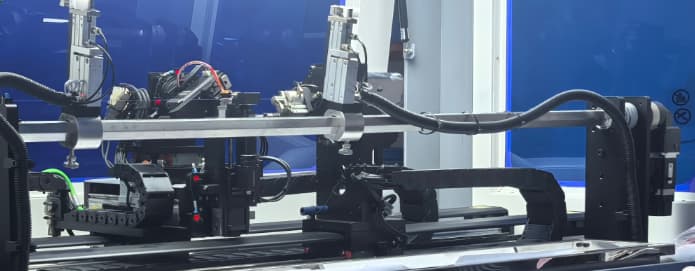
Manufacturing a Suture Barbed Cutting Machine is far more complex than simply cutting barbs into a surgical suture.
To produce premium-quality barbed sutures, every barb must have identical geometry, including barb height, length, angle, pitch, and surface finish. Even tiny variations can affect product consistency and clinical performance.
Achieving this level of precision requires the perfect integration of mechanical design, motion control, cutting technology, software, and inspection systems.
Below are some of the key engineering challenges.
1. Ultra-High Precision Motion Control
The biggest challenge is maintaining cutting precision throughout the entire production process.
During cutting, the blade moves forward at a constant speed while the suture continuously rotates.
Unlike conventional machining, these two movements must remain perfectly synchronized.
Any variation in:
- rotational angle
- rotational speed
- servo synchronization
- cutting depth
- blade entry angle
will directly influence the final barb geometry.
In addition, the blade itself has its own:
- cutting angle
- cutting depth
- elastic recovery (spring-back)
- penetration position
All of these parameters must work together precisely.
The challenge becomes even greater as the suture becomes longer.
Today, our system can manufacture barbed sutures with lengths of up to 900 mm, where maintaining consistent cutting accuracy across the entire suture becomes increasingly demanding.
2. Blade Technology Is More Difficult Than Most People Imagine
Many people assume that the machine itself determines the cutting quality.
In reality, the cutting blade is equally important.
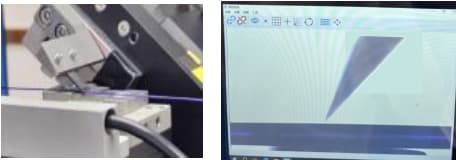
The blade is manufactured from tungsten carbide, providing excellent wear resistance and cutting performance.
However, producing a blade suitable for precision barb cutting remains highly specialized.
At present, the blade geometry is still finished through precision manual grinding rather than fully automated grinding equipment.
A high-quality blade can typically produce approximately 50,000 barbs before adjustment or replacement becomes necessary, depending on the material and production conditions.
Maintaining identical barb geometry throughout thousands of cutting cycles is one of the biggest technical challenges in barbed suture manufacturing.
3. Controlling Suture Rotation
Another major engineering challenge is controlling the rotation of the suture.
The machine rotates the suture continuously while the cutting blade enters at a fixed angle.
If rotational stability cannot be maintained, every barb may be produced under slightly different cutting conditions.
Our motion control system has been specifically developed to minimize rotational force variation and maintain stable synchronization between rotation and cutting motion, resulting in highly consistent barb geometry.
4. Why Are Blade, Motion Control, Recipe Management, and Vision Inspection Equally Important?
High-quality barb cutting is never achieved by one technology alone.
It requires the combination of several key systems.
Blade Technology
The cutting blade directly determines the surface finish and geometric accuracy of every barb.
Motion Control
High-precision servo motion ensures that every cutting cycle is repeated under identical conditions.
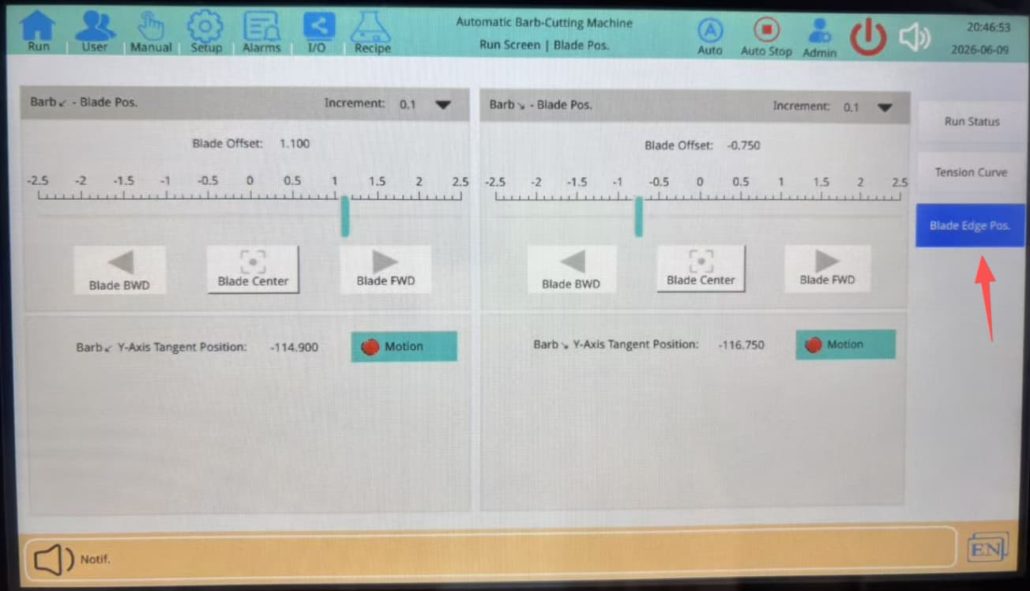
Intelligent Recipe Management
Our software allows operators to start production easily.
After loading the suture material, the operator simply selects the required Recipe, switches to Production Mode, and the machine automatically loads all production parameters.
This greatly simplifies machine operation while reducing setup errors.
Different materials and different barb geometries require different recipes, making recipe management essential for stable production.
5. Why Are PP and PDO Processed Differently?
Different suture materials require different manufacturing processes.
For example:
PDO / PGCL
- Stored under refrigerated conditions
- Opened only before production
- Nearly perfect round cross-section
- Excellent barb consistency
PP
- Stored at room temperature
- Elliptical cross-section
- Different mechanical characteristics
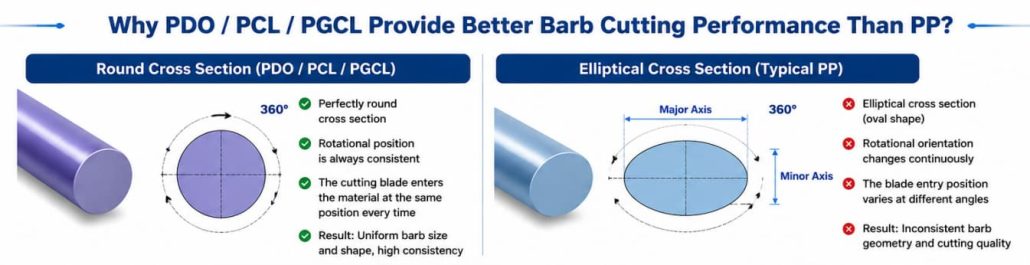
Because PDO and PGCL have a more uniform round cross-section, the cutting blade always enters the material under nearly identical conditions.
PP, however, typically has a slightly elliptical cross-section.
As the suture rotates, the blade contacts different surface positions, making it more difficult to maintain perfectly consistent barb geometry.
This is why different materials require different recipes and cutting strategies.
6. Why Is Blade Compensation Necessary?
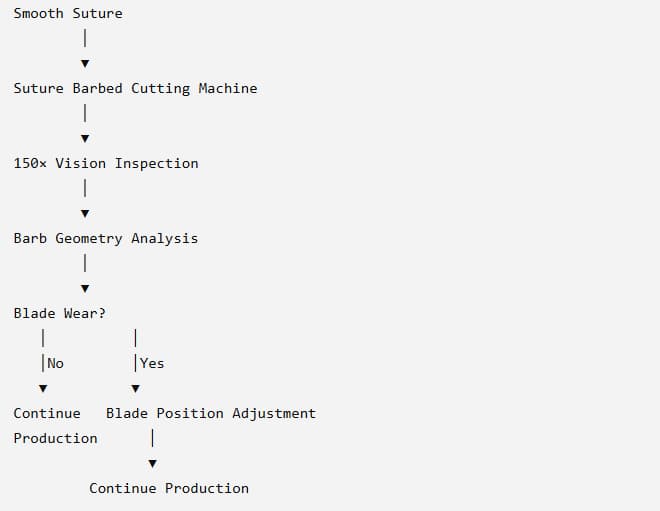
Even the highest-quality tungsten carbide blade gradually wears during continuous production.
Depending on the material being processed, measurable wear typically appears after 2–4 hours of operation.
Instead of replacing the blade immediately, our machine allows the operator to perform Blade Compensation.
By slightly adjusting the blade position, an unworn section of the cutting edge is brought into operation.
This extends blade life, reduces tooling costs, and maintains stable cutting quality.

7. Why Is Vision Inspection Essential?
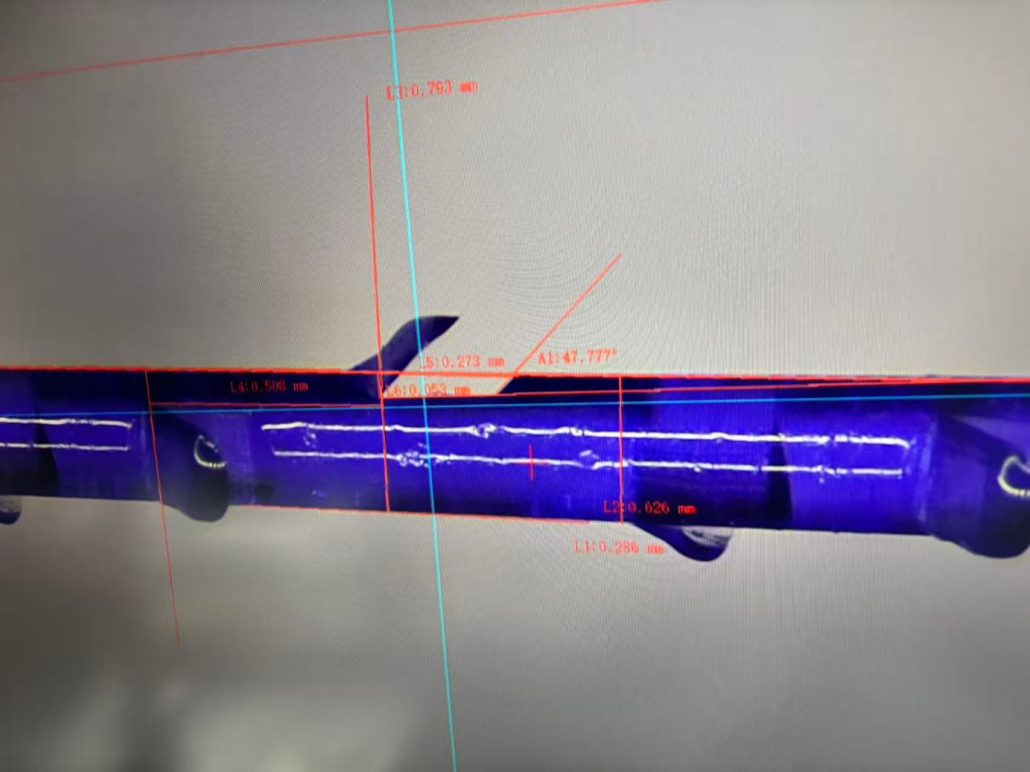
Although the Suture Barbed Cutting Machine incorporates an inline vision system for production monitoring, it cannot fully replace high-magnification inspection.
During production, the suture is continuously rotating and moving at high speed.
Under these dynamic conditions, it is difficult to capture every barb with the measurement accuracy required for detailed geometric analysis.
For this reason, finished samples are inspected using our dedicated Medical Suture Vision Inspection System.
The system magnifies the barbs by up to 150×, allowing engineers to evaluate:
- Barb height
- Barb length
- Barb angle
- Barb pitch
- Barb spacing
- Surface quality
- Cutting consistency
Our proprietary inspection software supports both automatic measurement and manual measurement, providing detailed inspection data that can be used to optimize recipes and improve production quality.
By combining precision cutting, intelligent recipe management, blade compensation, and high-magnification vision inspection, manufacturers can continuously optimize the production process and achieve consistent, high-quality barbed sutures.
Why Choose Changzhou Hotlink?
Manufacturing a high-precision Suture Barbed Cutting Machine requires expertise in precision mechanics, servo motion control, blade engineering, software development, and medical manufacturing processes.
At Changzhou Hotlink, we integrate all of these technologies into a complete solution, including:
- Suture Barbed Cutting Machine
- Automatic Needle Crimping Machine
- Automatic Suture Loop Machine
- Medical Suture Vision Inspection System
- Automatic Winding Machine
- Complete Barbed Suture Production Lines
Our goal is not only to provide machinery but also to help manufacturers produce high-quality, consistent, and commercially competitive barbed sutures.