
How Are Surgical Suture Needles Manufactured? A Complete Guide to the Suture Needle Manufacturing Process
Surgical suture needles are among the most critical instruments used in modern surgery. Whether in general surgery, cardiovascular procedures, ophthalmology, orthopedics, plastic surgery, or microsurgery, every suture needle must deliver exceptional strength, dimensional accuracy, and penetration performance.
Unlike ordinary metal products, surgical needles must meet extremely high medical standards. Even a slight variation in tip geometry, hole position, hardness, or surface finish can affect the surgeon’s handling experience and the overall success of the procedure.
Manufacturing high-quality suture needles therefore requires a carefully controlled production process. From selecting the appropriate stainless steel material to heat treatment, polishing, drilling, forming, and final surface treatment, every manufacturing stage contributes to the performance of the finished product.
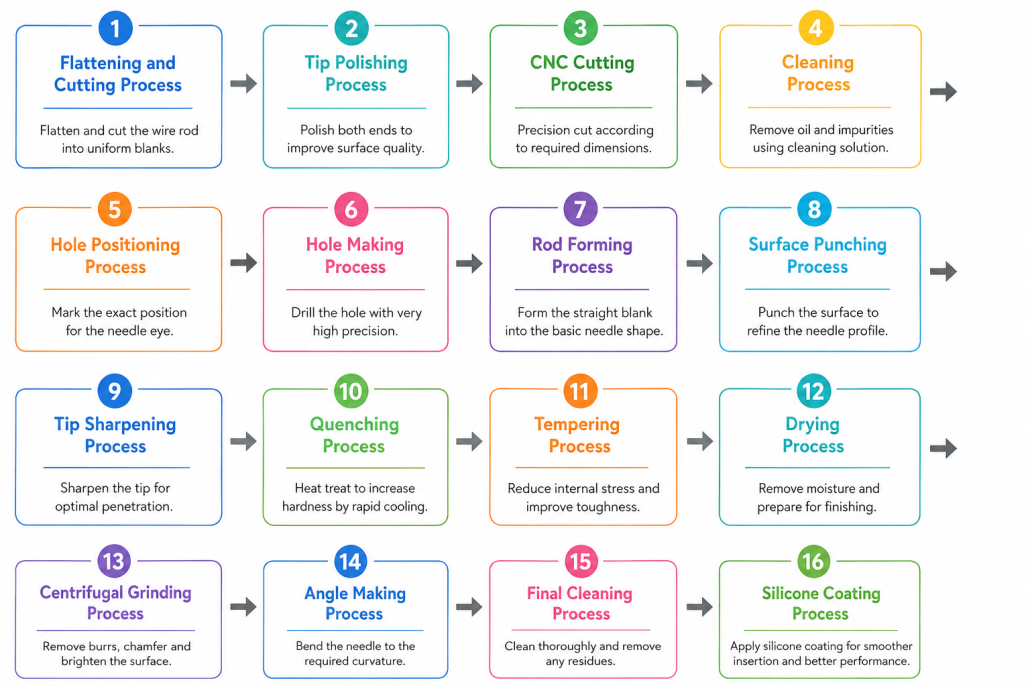
This article introduces the complete Suture Needle Manufacturing Process, following the actual production sequence used in a modern suture needle factory.
Why Is Manufacturing Surgical Suture Needles So Challenging?
Although surgical suture needles are small, they are among the most demanding medical components to manufacture.
Each needle must satisfy several critical requirements simultaneously:
- High mechanical strength
- Excellent penetration performance
- Stable elasticity
- Consistent hardness
- Smooth surface finish
- Accurate hole positioning
- Reliable dimensional consistency
Unlike ordinary industrial needles, surgical suture needles must pass through human tissue with minimal resistance while maintaining sufficient strength to avoid bending or breaking during surgery.
To achieve these characteristics, manufacturers must carefully control every production stage, from raw material selection to final cleaning.

Raw Material Selection
The manufacturing process begins with selecting suitable stainless steel.
Because surgical needles are medical products, the raw material must provide excellent corrosion resistance, mechanical strength, and process stability.
According to the production process, manufacturers commonly use:
- SS420J2 stainless steel manufactured in Korea
- 302 stainless steel
- 304 stainless steel manufactured in India (already heat treated)
These materials provide the combination of hardness, toughness, and corrosion resistance required for surgical needle production.
The stainless steel is normally supplied as continuous coils. Before entering production, the material is inspected to ensure it satisfies the required specifications for medical manufacturing.
Choosing high-quality raw material is the foundation of producing reliable surgical needles, because every subsequent manufacturing process depends on the consistency of the stainless steel.
Step 1 – Flattening and Cutting
After the stainless steel coils arrive at the factory, they cannot be used directly for manufacturing.
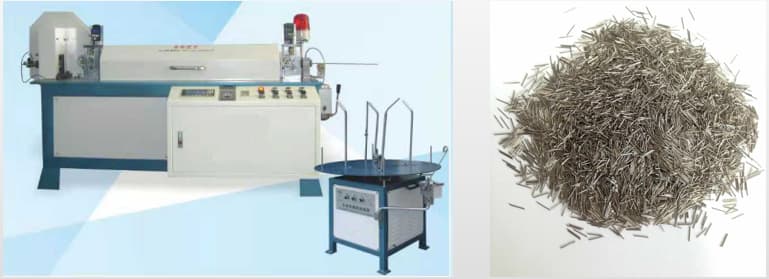
The coils must first pass through a Flattening and Cutting Machine.
During this process, the machine straightens the coiled stainless steel strip and cuts it into individual pieces according to the required needle length.
Accurate flattening is essential because even slight deformation of the material may affect the precision of the following machining processes.
The cutting length is controlled automatically to ensure every workpiece maintains consistent dimensions before moving to the next production stage.
The standard production capacity of one machine is approximately:
7,500 pieces per hour
This high-speed process provides stable productivity while maintaining dimensional consistency throughout mass production.
Step 2 – Polishing the Tip
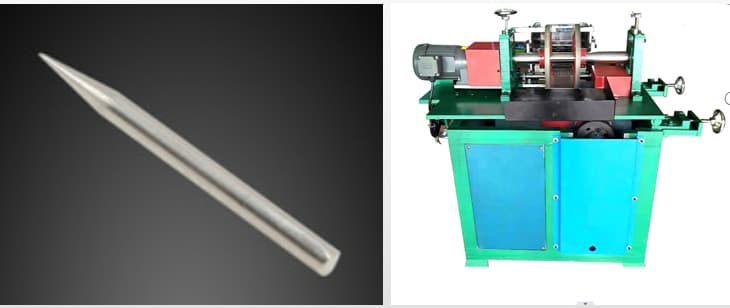
After cutting, each needle blank enters the Tip Polishing Machine.
This process polishes both ends of the needle blank to prepare the material for the following machining operations.
Consistent polishing improves surface quality and helps achieve more stable processing during later manufacturing stages.
According to the production process, this operation requires experienced operators because polishing quality directly influences the appearance and consistency of the finished surgical needle.
For large-scale production, manufacturers normally operate several polishing machines simultaneously.
Typical production capacity:
200,000 pieces per day (10-hour production)
Normally:
- One operator can manage 1–2 machines
- One needle size usually requires one dedicated machine
- A factory generally installs 3–5 polishing machines to support continuous production
Proper tip polishing helps improve production stability while preparing the needle blanks for precision machining.
Step 3 – CNC Cutting
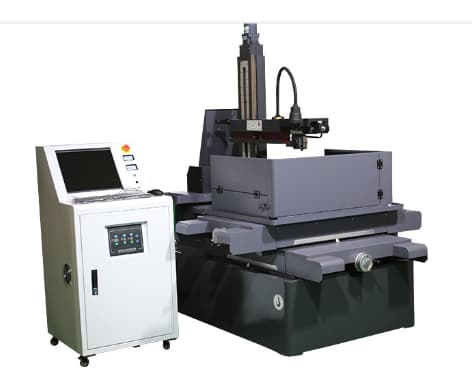
After polishing, the needle blanks enter the CNC Cutting Machine.
The CNC machine accurately cuts the processed material into two individual needle blanks according to the required dimensions.
Because surgical needles require extremely high dimensional accuracy, CNC control provides stable repeatability throughout continuous production.
Typical production capacity:
1,000 pieces per hour
Accurate CNC cutting ensures every needle blank maintains consistent length before entering the subsequent cleaning and hole-forming processes.
Step 4 – Cleaning the Needles
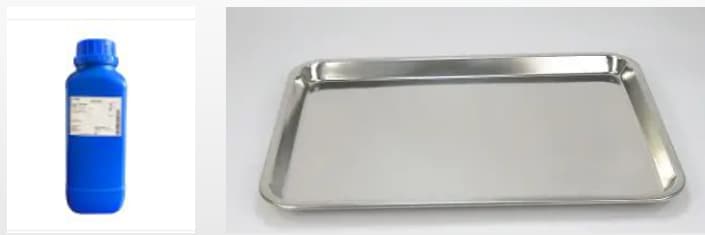
After CNC cutting, the needle blanks are cleaned.
The purpose of this cleaning process is to remove machining residue, oil, and contaminants remaining on the needle surface.
According to the manufacturing process, methyl propyl ketone is used to clean the surface of the needles.
Effective cleaning helps remove production contaminants before precision machining continues, improving process stability during the following hole-positioning and drilling operations.
Maintaining a clean surface is particularly important because contaminants may influence machining accuracy or affect the final surface quality of the surgical needle.
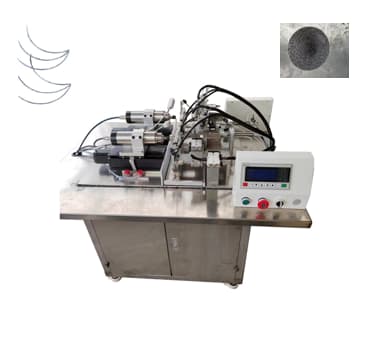
Step 5 – Position the Hole in the Needles
After cleaning, the needle blanks proceed to the Hole Positioning Process.
Before drilling the eye of the needle, the correct hole position must first be established. This step creates a positioning point on the needle, ensuring that the subsequent hole-making process can be performed accurately and consistently.
Because the eye of the needle is one of the most critical features of a surgical suture needle, accurate positioning directly affects the quality of the finished product. If the positioning is inaccurate, the drilled hole may be off-center, which can influence the needle’s strength, appearance, and its ability to securely hold the suture.
The positioning machine is designed to create a precise reference point before the hole is drilled deeper into the stainless steel needle blank.
Typical production speed:
15–20 pieces per minute
Stable positioning helps improve machining accuracy while reducing the possibility of defective products during the following drilling process.
Step 6 – Making Hole in the Needles
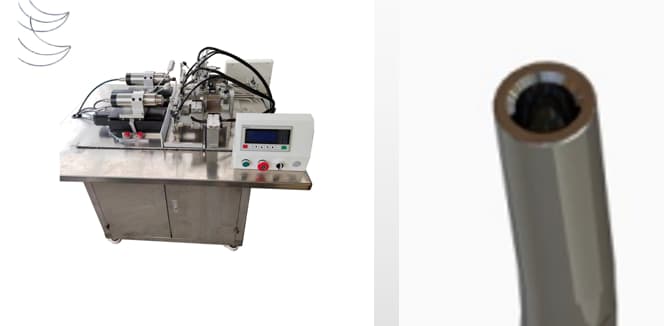
Once the positioning point has been created, the needle enters the Hole Making Machine.
This machine drills the eye of the surgical needle according to the required dimensions. The hole diameter, depth, and machining parameters can all be adjusted to accommodate different needle sizes and product specifications.
Since different surgical needles require different suture diameters, the hole dimensions must be accurately controlled to ensure that the suture can be securely attached without reducing the mechanical strength of the needle.
High machining precision also minimizes burr formation and provides a smooth hole surface, making the following manufacturing processes more stable.
Typical production speed:
10–14 pieces per minute
By adjusting the tooling and machine settings, manufacturers can produce a wide range of surgical needle specifications on the same machine.
Step 7 – Rod Forming Machine
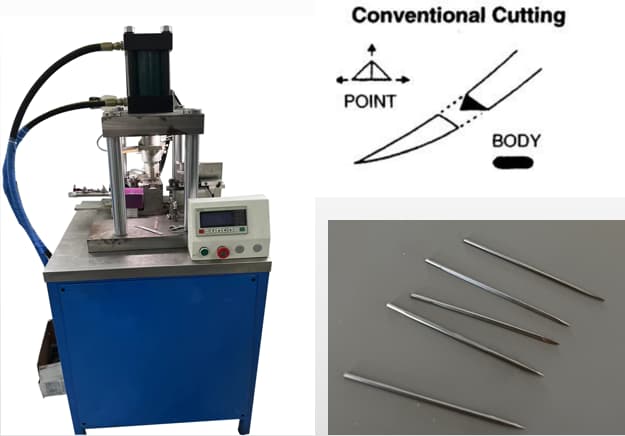
After the hole has been completed, the needle blank enters the Rod Forming Machine.
This process forms the cutting profile shown in the product drawing. Depending on the needle design, the forming operation produces the required geometry for the following sharpening process.
The forming accuracy is important because it determines the consistency of the needle body before the cutting tip is produced.
The machine is capable of processing different needle specifications by changing the corresponding tooling.
Typical production speed:
18–23 pieces per minute
Stable forming ensures that each surgical needle maintains uniform dimensions and provides a consistent foundation for the subsequent manufacturing operations.
Step 8 – Punching Machine Press the Surface
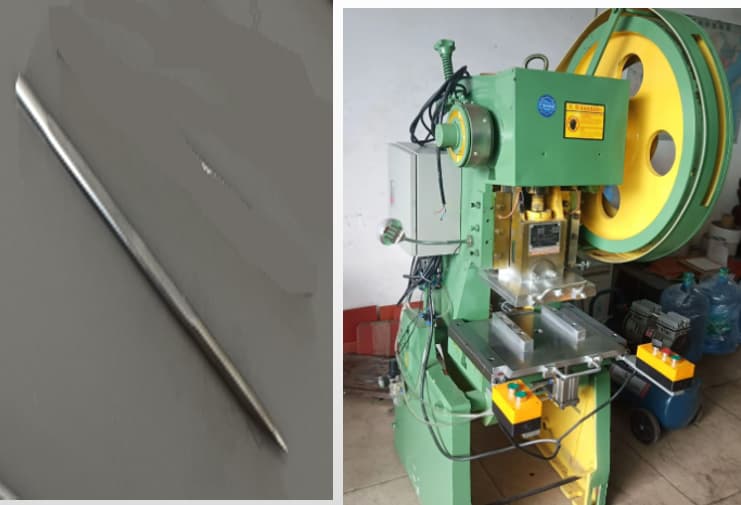
Following rod forming, the surgical needle enters the Punching Machine.
This process presses the surface of the needle according to the product design.
The punching operation improves the required surface shape before the needle proceeds to the tip sharpening process. Accurate pressing also helps maintain consistent dimensions throughout mass production.
Typical production speed:
80–100 pieces per minute
Because this operation is performed automatically, the punching machine provides stable production efficiency while maintaining repeatable product quality.
Step 9 – Tip Sharper Machine
The next manufacturing stage is Tip Sharpening.
The Tip Sharper Machine produces the final needle point according to the required needle design.
The sharpness of a surgical needle directly influences tissue penetration during surgery. Therefore, this process requires high machining precision and stable process control to ensure consistent tip geometry.
The sharpening machine processes every needle according to the specified dimensions, producing uniform tip quality suitable for medical applications.
Typical production capacity:
7,500 pieces per hour
After sharpening, the surgical needle has obtained its final penetration tip and is ready for the subsequent heat treatment processes that further improve its mechanical properties.
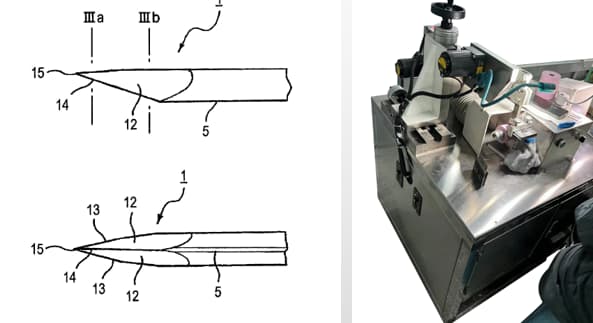
Step 10 – Quenching
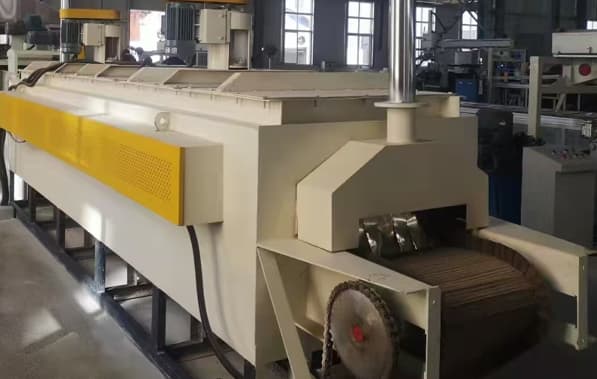
After the needle tip has been sharpened, the surgical needles enter the Quenching Machine.
Quenching is one of the most important heat treatment processes in surgical needle manufacturing. Its primary purpose is to increase the hardness of the stainless steel, allowing the needle to maintain sufficient strength and wear resistance during surgical procedures.
According to the production process, the quenching machine operates with the addition of alcohol and oxygen during the heat treatment process. Under carefully controlled conditions, the needles are rapidly heated and then cooled to achieve the required metallurgical structure.
The production capacity of the quenching machine is approximately:
1,000,000 pieces per day
Stable quenching ensures that every surgical needle obtains consistent hardness before proceeding to the tempering process.
Step 11 – Tempering
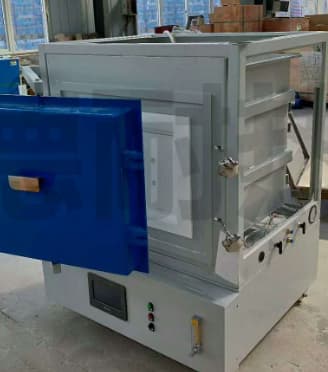
Immediately after quenching, the needles are transferred to the Tempering Machine.
Although quenching significantly increases hardness, it also makes the needles more brittle. Tempering is therefore necessary to improve toughness while maintaining the required hardness.
During tempering, the needles are heated under controlled conditions to relieve internal stress generated during quenching. This process improves the balance between hardness and flexibility, reducing the risk of breakage during surgical use.
Proper tempering is essential because a surgical needle must be strong enough to penetrate tissue while remaining sufficiently tough to resist cracking or fracture.
After tempering, the needles possess the mechanical properties required for the following finishing processes.
Step 12 – Drying
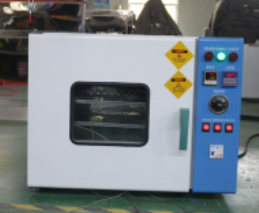
Following heat treatment, the needles enter the Dryer.
The drying process removes moisture remaining on the needle surface after previous manufacturing operations.
A completely dry surface is important before the needles proceed to mechanical finishing. Removing residual moisture also helps maintain a clean production environment and prepares the needles for the next manufacturing stage.
The drying process is simple but essential for ensuring stable downstream production.
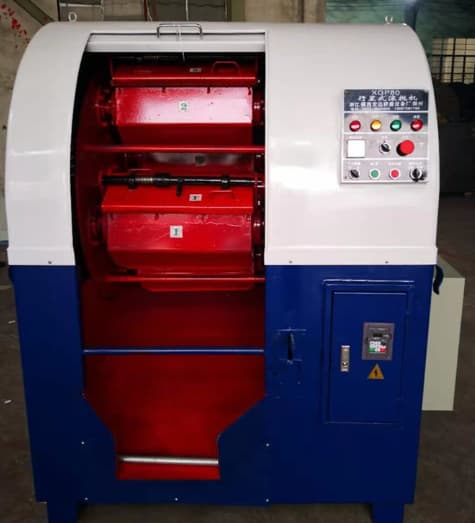
Step 13 – Centrifugal Grinding
After drying, the needles enter the Centrifugal Grinder.
This machine is used for:
- Brightening
- Chamfering
- Deburring
During centrifugal grinding, the needle surface is processed to remove small burrs and improve the overall surface finish.
The process also enhances the appearance of the surgical needle by producing a brighter and smoother surface while eliminating sharp edges that may remain from previous machining operations.
A uniform surface finish contributes to product consistency and prepares the needles for the following angle-forming process.
Step 14 – Angle Making
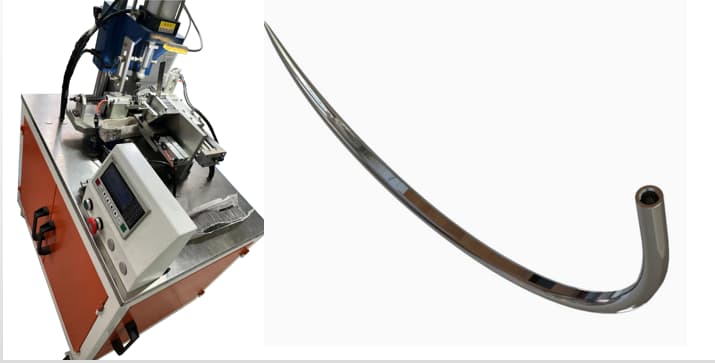
The finished needle blanks are then transferred to the Angle Making Machine.
This machine bends the straight needle into the required curved shape according to the product specification.
Different surgical procedures require different needle curvatures, such as straight needles, 1/4 circle, 3/8 circle, 1/2 circle, or other specialized designs. The Angle Making Machine forms the required geometry while maintaining dimensional consistency throughout production.
Typical production speed:
15–22 pieces per minute
Accurate angle forming ensures that each needle meets the required shape before final cleaning.
Step 15 – Cleaning Machine and Oven
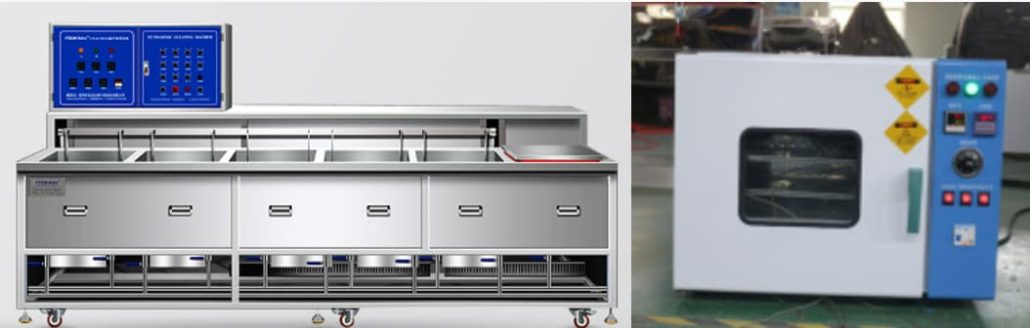
Before the needles can be assembled with sutures and packaged, they must undergo a final cleaning process.
The Cleaning Machine and Oven thoroughly clean the needle surface to remove any remaining contaminants generated during previous manufacturing operations.
After cleaning, the needles are dried in the integrated oven to ensure that the surface is clean and dry before the next process.
A clean needle surface is essential for maintaining product quality before suture attachment and packaging.
Step 16 – Add Silicone Oil
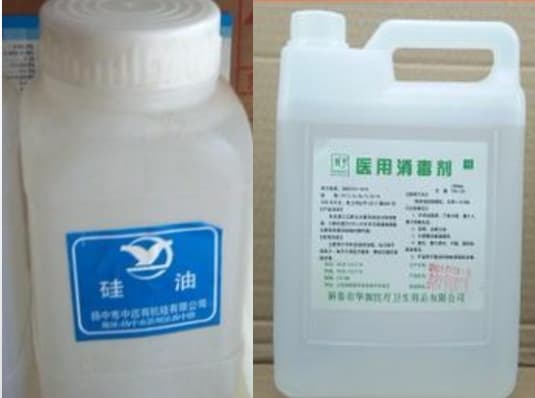
The final manufacturing step is Silicone Coating.
A thin layer of silicone oil is applied to the surface of the surgical needles.
The silicone coating helps reduce friction during tissue penetration and improves the smoothness of needle insertion during surgical procedures.
Uniform silicone application also contributes to consistent product performance and enhances the overall user experience for surgeons.
After silicone coating, the surgical needles are ready for suture attachment and final packaging.
Conclusion
The complete Surgical Suture Needle Manufacturing Process consists of the following sixteen production steps:
- Material Selection
- Flattening and Cutting
- Polishing the Tip
- CNC Cutting
- Cleaning the Needles
- Position the Hole in the Needles
- Making Hole in the Needles
- Rod Forming
- Punching Machine Press the Surface
- Tip Sharper Machine
- Quenching
- Tempering
- Dryer
- Centrifugal Grinder
- Angle Making
- Cleaning Machine and Oven
- Add Silicone Oil
Each process plays an important role in producing high-quality surgical needles with excellent dimensional accuracy, mechanical strength, surface finish, and penetration performance.
By maintaining strict quality control throughout every manufacturing stage, manufacturers can consistently produce surgical needles that meet the demanding requirements of modern medical applications.
Complete Suture Needle Production Solution
In addition to supplying individual machines, Changzhou Hotlink Electronics Co., Ltd. provides complete solutions for establishing a surgical suture needle manufacturing facility.
Our one-stop solution includes:
- Suture needle production equipment
- Raw materials, including stainless steel strips
- Packaging materials
- Cleaning and water treatment solutions
- Technical training
- Production process support
- Factory planning and equipment integration
Whether you are expanding an existing production line or building a new suture needle factory, we can provide customized manufacturing solutions based on your production capacity and product requirements.