The Ultimate Guide to Surgical Suture Needle Manufacturing: Process, Equipment, Materials, Quality Control, and Turnkey Factory Solutions
Introduction
Surgical suture needles are among the most essential medical devices used in modern healthcare. Every day, millions of surgical procedures rely on high-quality needles to close wounds, reconnect tissues, repair blood vessels, and support healing. Whether in cardiovascular surgery, orthopedic procedures, plastic surgery, ophthalmology, microsurgery, or general surgery, the quality of the surgical needle directly affects surgical precision, tissue trauma, and patient recovery.
Although a surgical needle appears to be a simple product, manufacturing one is an extremely sophisticated engineering process. Every needle must meet strict requirements for dimensional accuracy, mechanical strength, penetration performance, corrosion resistance, and surface smoothness. Even microscopic deviations in needle geometry, hole position, tip sharpness, or heat treatment can significantly affect surgical performance.
Unlike conventional industrial metal products, surgical suture needles must comply with demanding medical manufacturing standards. Manufacturers are required to maintain exceptional consistency throughout mass production while ensuring that every needle performs identically in the operating room.
As global demand for minimally invasive surgery and advanced medical devices continues to grow, manufacturers are increasingly investing in automated production technologies to improve efficiency, reduce labor costs, and achieve higher product consistency.
This comprehensive guide explains the complete Surgical Suture Needle Manufacturing Process, introduces the key manufacturing equipment used in modern factories, discusses quality control throughout production, and explores how automated production lines are transforming the medical device manufacturing industry.
Whether you are planning to build a new surgical needle factory, upgrade an existing production line, or simply gain a deeper understanding of how surgical needles are manufactured, this guide provides a complete overview of the entire manufacturing process.
What Is a Surgical Suture Needle?
A surgical suture needle is a precision medical instrument designed to carry surgical sutures through biological tissue with minimal trauma. Unlike ordinary sewing needles, surgical needles are engineered specifically for medical applications, requiring exceptional mechanical performance, dimensional precision, and biocompatibility.
A typical surgical needle consists of three primary sections:
Needle Point
The needle point is the first part to penetrate tissue. Different point designs are developed for specific surgical applications. The geometry of the needle tip determines penetration efficiency, tissue damage, and surgical handling characteristics.
Needle Body
The needle body provides the structural strength necessary to withstand bending forces during surgery. Its diameter, curvature, flexibility, and surface finish all influence how easily the surgeon can manipulate the needle.
Needle Eye or Attachment End
Depending on the needle design, the rear end of the needle either contains a precisely machined hole for attaching the suture or is manufactured as an eyeless (swaged) needle designed for permanent suture attachment. Accurate machining of this section is critical because it directly affects suture retention strength and overall product reliability.
Because each portion of the needle performs a specific function, manufacturers must carefully control every machining process throughout production.

Types of Surgical Suture Needles
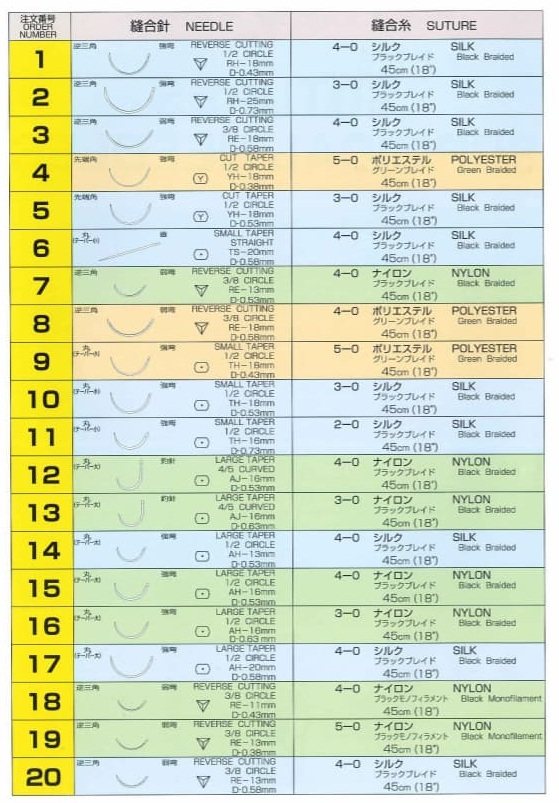
Modern surgery requires many different needle configurations. Various surgical specialties demand different penetration characteristics, curvatures, and dimensions.
Some of the most common surgical needle types include:
Straight Needle
Straight needles are commonly used where tissues are easily accessible and can be manipulated directly. They are frequently applied in skin closure and certain dental procedures.
One-Quarter Circle Needle
The 1/4 circle needle provides a relatively shallow curvature and is commonly selected for ophthalmic procedures and microsurgery where precise control is essential.
Three-Eighth Circle Needle
The 3/8 circle needle is one of the most widely used surgical needle designs worldwide. It offers an excellent balance between accessibility and maneuverability, making it suitable for general surgery, plastic surgery, gastrointestinal surgery, and numerous other procedures.
One-Half Circle Needle
The 1/2 circle needle provides a deeper curvature, allowing surgeons to operate effectively within confined surgical spaces. It is frequently used in abdominal, thoracic, urological, and gynecological surgeries.
Five-Eighth Circle Needle
The 5/8 circle needle is designed for procedures performed in extremely restricted operating fields. Its tighter curvature enables surgeons to manipulate the needle where access is limited.
Each needle geometry requires highly precise forming equipment during manufacturing. Even slight variations in curvature may influence surgical performance and user experience.
Why Is Surgical Suture Needle Manufacturing So Challenging?
Although surgical needles are small components, they represent one of the most technically demanding products in medical manufacturing.
Every production step must achieve an exceptionally high level of precision because multiple quality characteristics must be controlled simultaneously.
Dimensional Accuracy
The diameter, length, curvature, and hole position of every needle must remain highly consistent throughout mass production.
Small dimensional variations may affect needle balance, tissue penetration, or compatibility with surgical sutures.
Modern production equipment therefore relies on precision tooling and stable manufacturing processes to ensure repeatable dimensional accuracy.
Tip Sharpness
The needle point determines how easily the needle penetrates tissue.
A properly manufactured tip reduces insertion force while minimizing tissue trauma.
If the tip geometry varies between batches, surgeons may immediately notice differences in penetration performance during clinical use.
Maintaining consistent tip sharpness therefore becomes one of the most important objectives throughout production.
Heat Treatment
One of the greatest engineering challenges is balancing hardness and toughness.
If a needle is excessively hard, it becomes brittle and may fracture during surgery.
If it is too soft, it may bend while penetrating tissue.
The heat treatment process—including quenching and tempering—must therefore be carefully controlled to achieve the desired mechanical properties.
Hole Precision
For eyed surgical needles, the hole is one of the most critical features.
Its diameter, depth, and position directly influence how securely the suture is retained.
A poorly machined hole can weaken the needle or reduce the reliability of suture attachment.
Consequently, manufacturers devote significant attention to precision positioning and hole-making processes.
Surface Finish
Surface quality plays an important role in surgical performance.
A smooth needle surface reduces friction during tissue penetration and contributes to better handling characteristics.
Throughout manufacturing, multiple finishing processes are used to improve surface quality, remove burrs, and enhance product consistency.
Manufacturing Consistency
Modern medical manufacturers often produce hundreds of thousands—or even millions—of surgical needles every day.
Achieving identical quality across such high production volumes requires advanced automation, precision tooling, standardized process control, and rigorous quality management.
Consistency is not achieved by a single machine but through the coordination of every manufacturing process across the entire production line.
Raw Material Selection: The Foundation of High-Quality Surgical Needles
Every high-quality surgical suture needle begins with the careful selection of raw materials. Although a surgical needle is small in size, its performance depends heavily on the mechanical properties of the stainless steel used during manufacturing.
Medical-grade stainless steel must provide an excellent balance of hardness, toughness, corrosion resistance, and processability. These characteristics ensure that the finished needle can penetrate tissue smoothly while maintaining sufficient strength to resist bending or breaking during surgery.
According to the manufacturing process, the commonly used raw materials include:
SS420J2 Stainless Steel (Korea)
SS Stainless Steel(Japan)
SS304/302 Stainless Steel (India, Heat Treated)
Each material offers different characteristics depending on the intended needle design and manufacturing process. Selecting stable and consistent raw materials is the first step toward producing surgical needles that meet the demanding requirements of the medical industry.
Before production begins, incoming stainless steel materials are inspected to verify dimensions, surface condition, and material consistency. Only qualified materials proceed to the manufacturing line.
Complete Surgical Suture Needle Manufacturing Process
Modern surgical needle production consists of a series of precision manufacturing operations. Each process prepares the workpiece for the next stage, gradually transforming stainless steel into a finished surgical needle with the required geometry, mechanical properties, and surface quality.
The following manufacturing sequence reflects the actual production process used in a surgical suture needle factory.
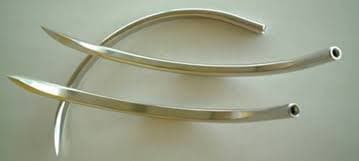
Step 1 – Flattening and Cutting Process
The manufacturing process begins with Flattening and Cutting.
Raw stainless steel is supplied in coil form. Before further machining can begin, the material must be straightened and cut into individual blanks.
The Flattening and Cutting Machine continuously feeds the stainless steel strip through a precision straightening system, removing any curvature introduced during coiling. Once the material is completely flattened, it is automatically cut to the required length according to the needle specification.
Accurate straightening is essential because any residual deformation can negatively affect the precision of subsequent manufacturing processes, particularly hole positioning, forming, and tip machining.
Automatic cutting also ensures that every needle blank has consistent dimensions, providing a stable foundation for downstream production.
Key Advantages
- High cutting consistency
- Accurate material length
- Stable feeding performance
- Suitable for continuous mass production
Production Capacity
Approximately 7,500 pieces per hour
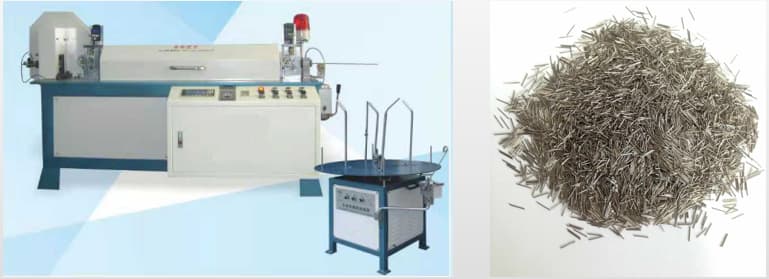
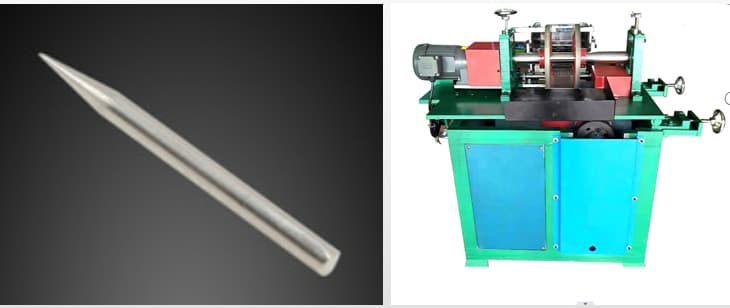
Step 2 – Tip Polishing Process
After cutting, each needle blank enters the Tip Polishing Process.
At this stage, both ends of the stainless steel blank are polished to improve surface quality and prepare the material for subsequent precision machining.
Polishing removes minor surface imperfections generated during cutting while producing a more uniform surface finish. Stable polishing also helps improve machining consistency during later processes such as CNC cutting and hole machining.
Depending on production capacity, manufacturers typically operate several polishing machines simultaneously to maintain continuous production.
Why Is Tip Polishing Important?
Although this process does not create the final needle point, it plays an important role in preparing the workpiece for precision machining.
Consistent polishing contributes to:
- Improved dimensional consistency
- Better machining stability
- Reduced surface defects
- Higher overall product quality
Production Capacity
Approximately 200,000 pieces per day (10-hour production)
Typically:
- One operator manages one or two machines.
- One machine is generally dedicated to a specific needle size.
- A production line may include three to five polishing machines depending on output requirements.
Step 3 – CNC Cutting Process
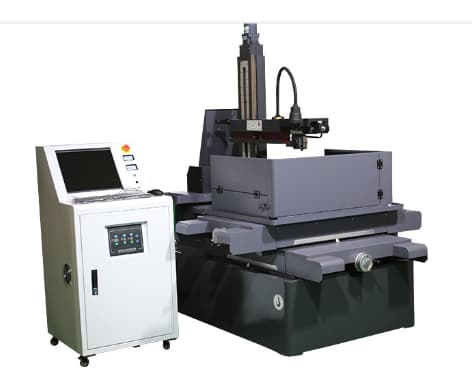
Once polishing is completed, the needle blanks proceed to the CNC Cutting Process.
The CNC Cutting Machine performs precision cutting according to the required product dimensions. Computer numerical control ensures excellent repeatability and minimizes dimensional variation during continuous production.
Compared with conventional cutting methods, CNC machining provides significantly higher accuracy and better process stability, making it particularly suitable for medical manufacturing where consistency is essential.
Each workpiece is accurately machined before entering the next production stage.
Benefits of CNC Cutting
- Excellent dimensional accuracy
- Stable production quality
- High repeatability
- Reduced manual intervention
Production Capacity
Approximately 1,000 pieces per hour
Step 4 – Cleaning Process
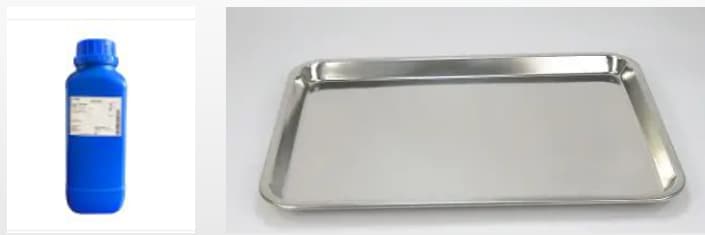
Following CNC cutting, the needle blanks undergo the Cleaning Process.
During machining, small metal particles, cutting residues, lubricants, and contaminants may remain on the surface of the workpiece. These impurities must be removed before precision hole machining begins.
According to the manufacturing process, methyl propyl ketone is used during cleaning to remove machining residues from the needle surface.
A clean workpiece improves the stability of subsequent machining operations and helps maintain consistent product quality throughout production.
Proper cleaning also reduces the possibility of contamination being carried into later manufacturing processes.
Purpose of Cleaning
- Remove machining residues
- Eliminate oil and contaminants
- Improve subsequent machining accuracy
- Prepare the workpiece for precision hole positioning
After cleaning, the needle blanks are ready to enter one of the most critical stages of production—hole positioning and hole making, where the attachment point for the surgical suture is precisely manufactured.
Step 5 – Hole Positioning Process
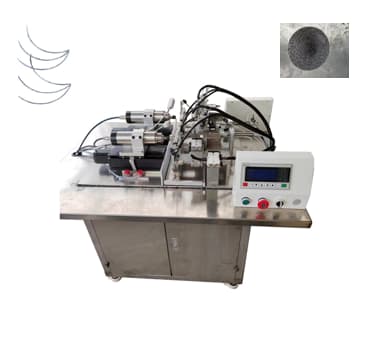
After the needle blanks have been thoroughly cleaned, they proceed to the Hole Positioning Process.
Although the eye of a surgical needle appears to be a small feature, its position is one of the most critical dimensions in the entire manufacturing process. Before the hole can be drilled, a precise reference point must first be created on the needle blank. This positioning operation ensures that every subsequent drilling process is performed at exactly the correct location.
Even a slight deviation in hole position can reduce the mechanical strength of the needle, affect the balance of the finished product, or interfere with secure suture attachment. For this reason, manufacturers place great emphasis on maintaining positioning accuracy throughout production.
The Hole Positioning Machine creates a consistent positioning mark on every needle blank according to the product specification. Stable positioning improves repeatability and provides a reliable foundation for the following hole-making operation.
Why Is Hole Positioning Important?
Hole positioning directly influences several key quality characteristics of a surgical needle:
- Consistent location of the needle eye
- Stable machining accuracy
- Improved product consistency
- Reduced rejection caused by off-center holes
- Better suture attachment performance
Because every needle size has different dimensional requirements, the positioning process must be carefully adjusted according to the product specification.
Production Capacity
Approximately 15–20 pieces per minute
Step 6 – Hole Making Process
After positioning has been completed, the needle blank moves to the Hole Making Process.
This stage produces the needle eye by machining a hole according to the required diameter and depth. The eye is the connection point between the surgical needle and the suture, making it one of the most important functional features of the finished product.
The Hole Making Machine is capable of processing different needle specifications by adjusting tooling and machining parameters. Depending on the product design, manufacturers can control the hole diameter, machining depth, and processing conditions to meet different production requirements.
Precision during this process is essential because the needle eye must securely hold the suture while preserving the mechanical strength of the needle body. A properly machined hole also provides a smooth internal surface, reducing the possibility of damage to the suture during attachment or clinical use.
Advantages of Precision Hole Making
- Accurate hole diameter
- Consistent machining depth
- Smooth internal hole surface
- High machining repeatability
- Reliable suture attachment
Production Capacity
Approximately 10–14 pieces per minute
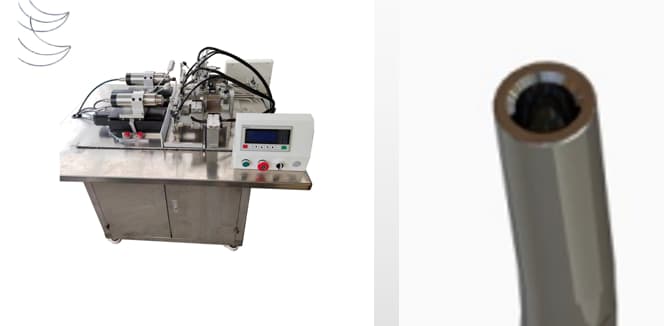
Step 7 – Rod Forming Process
Following hole machining, the needle blank enters the Rod Forming Process.
At this stage, the Rod Forming Machine shapes the needle body according to the required product drawing. This process establishes the basic geometry of the needle before the final tip sharpening operation.
Consistent forming is essential because it determines the dimensional accuracy of the needle body. Variations during forming may influence later processes and ultimately affect the performance of the finished surgical needle.
Different needle models require different tooling configurations, allowing manufacturers to produce a wide range of specifications while maintaining stable product quality.
Key Benefits of Rod Forming
- Accurate needle geometry
- Consistent dimensions
- High production repeatability
- Flexible tooling for different needle specifications
Production Capacity
Approximately 18–23 pieces per minute
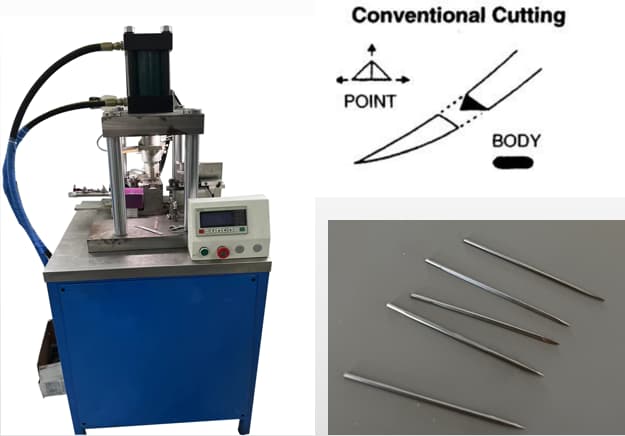
Step 8 – Surface Punching Process
After rod forming, the needle proceeds to the Surface Punching Process.
The Punching Machine presses the surface of the needle according to the product design. This operation refines the needle profile and prepares it for the subsequent tip sharpening process.
Stable punching improves dimensional consistency and helps ensure that every needle maintains the required shape throughout mass production.
Because the process is performed automatically, manufacturers can achieve both high production efficiency and excellent repeatability.
Advantages of Surface Punching
- Consistent surface profile
- Stable product dimensions
- High-speed automatic production
- Improved production efficiency
Production Capacity
Approximately 80–100 pieces per minute
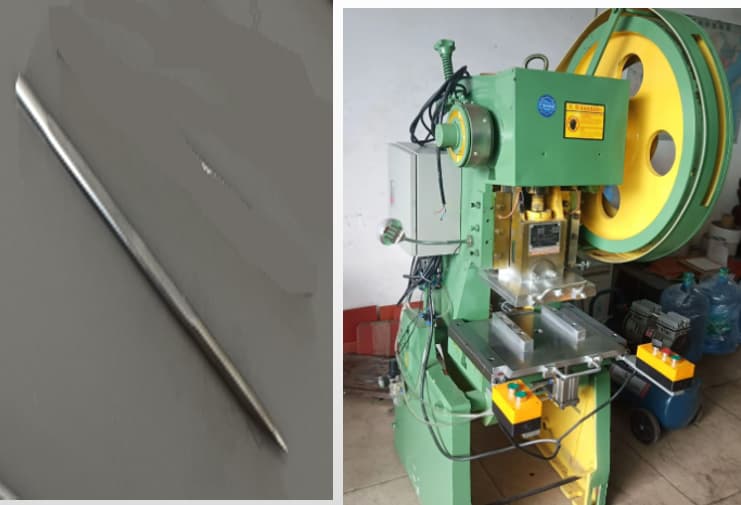
Step 9 – Tip Sharpening Process
The next stage is the Tip Sharpening Process, one of the most important operations in surgical needle manufacturing.
The performance of a surgical needle depends heavily on the quality of its tip. A properly sharpened needle penetrates tissue smoothly, reduces insertion force, minimizes tissue trauma, and provides surgeons with greater control during suturing.
Using the Tip Sharper Machine, each needle is machined to produce the specified point geometry. The sharpening process is carefully controlled to ensure that every needle achieves consistent penetration performance.
Because different surgical applications require different needle point designs, the sharpening process must maintain excellent repeatability while meeting the required product specifications.
Why Is Tip Sharpening So Critical?
The quality of the needle point directly affects:
- Tissue penetration performance
- Surgical handling
- Reduced insertion force
- Lower tissue trauma
- Product consistency
For this reason, tip sharpening is regarded as one of the most critical precision machining operations in the entire production line.
Production Capacity
Approximately 7,500 pieces per hour
From Needle Blank to Functional Surgical Needle
By the completion of the first nine manufacturing stages, the stainless steel material has been transformed into a precisely machined surgical needle blank with its essential geometric features already established.
However, although the needle has now reached its final shape, it has not yet achieved the mechanical properties required for surgical use. The following stages—Quenching, Tempering, Drying, Centrifugal Grinding, Angle Making, Final Cleaning, and Silicone Coating—are responsible for enhancing hardness, toughness, surface finish, and overall performance before the needle is ready for suture attachment and final packaging.
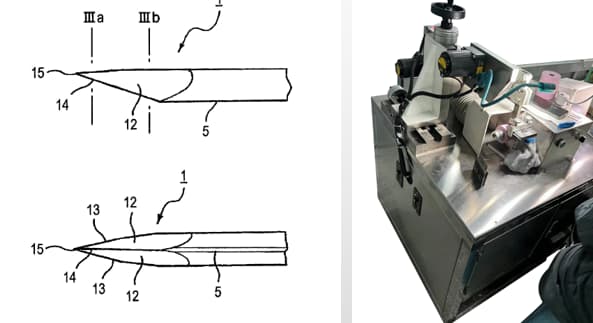
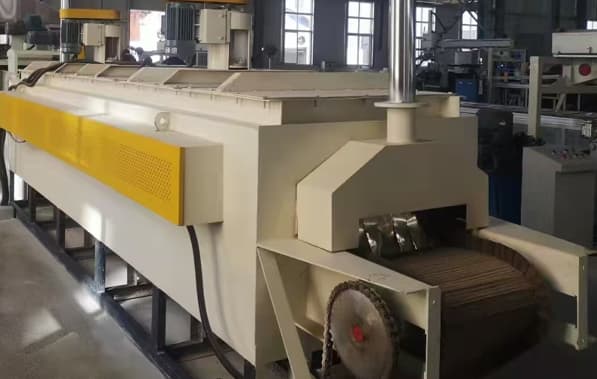
Step 10 – Quenching Process
After the needle tip has been precisely sharpened, the surgical needles enter the Quenching Process, which is one of the most critical heat treatment stages in the entire manufacturing process.
Although the needle has already reached its final geometry after the previous machining operations, its mechanical properties have not yet been fully developed. At this stage, the stainless steel must undergo heat treatment to achieve the hardness required for surgical applications.
During the quenching process, the needles are heated to a controlled temperature and then rapidly cooled. According to the manufacturing process, alcohol and oxygen are used during this operation to support stable heat treatment conditions.
Rapid cooling changes the internal metallurgical structure of the stainless steel, significantly increasing its hardness and wear resistance. These characteristics enable the finished needle to maintain a sharp point and withstand repeated penetration through biological tissue.
Maintaining stable temperature control throughout quenching is essential because variations in heating or cooling conditions can lead to inconsistent hardness among different production batches.
Why Is Quenching Important?
Quenching provides several important benefits:
- Increases needle hardness
- Improves wear resistance
- Maintains penetration performance
- Enhances dimensional stability
- Prepares the needle for tempering
Without proper quenching, the surgical needle may become too soft, causing the tip to wear quickly or the needle body to bend during clinical use.
Production Capacity
Approximately 1,000,000 pieces per day
Step 11 – Tempering Process
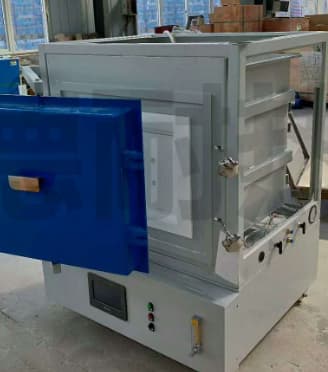
Immediately after quenching, the needles enter the Tempering Process.
While quenching greatly increases hardness, it also introduces internal stress into the stainless steel. If these stresses are not properly relieved, the needle may become excessively brittle and more susceptible to cracking or fracture.
Tempering carefully reheats the needles under controlled conditions to reduce internal stress while preserving the hardness achieved during quenching.
This process creates an optimal balance between hardness and toughness, allowing the finished surgical needle to resist both bending and breakage during surgical procedures.
For surgical needles, achieving this balance is essential. A needle that is too hard may fracture unexpectedly, while a needle that is too soft may deform before passing through tissue.
Manufacturers therefore carefully control the tempering parameters to ensure consistent mechanical performance throughout mass production.
Benefits of Tempering
- Relieves internal stress
- Improves toughness
- Reduces brittleness
- Maintains required hardness
- Extends product reliability
Together, quenching and tempering establish the final mechanical properties of the surgical needle.
Step 12 – Drying Process
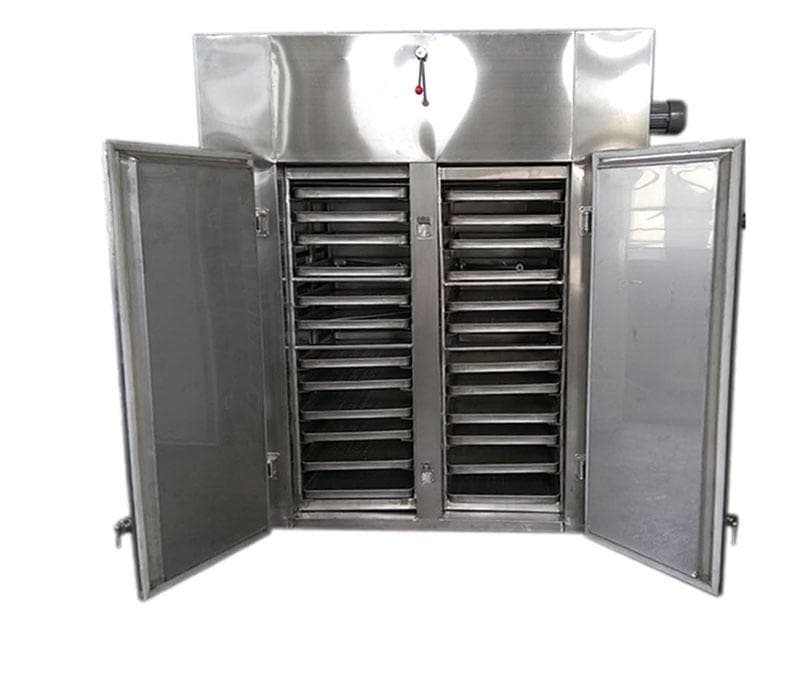
Following heat treatment, the needles proceed to the Drying Process.
During previous manufacturing operations, the needle surface may retain moisture or residues from cleaning and heat treatment. Before surface finishing can begin, these materials must be completely removed.
The Dryer eliminates residual moisture from every needle, ensuring that the surface is clean and dry before entering the next production stage.
Although drying is a relatively simple process, it contributes to stable downstream production by preventing unwanted contamination and ensuring consistent processing conditions.
Purpose of Drying
- Remove residual moisture
- Prepare the surface for finishing
- Improve process consistency
- Support stable downstream production
Step 13 – Centrifugal Grinding Process
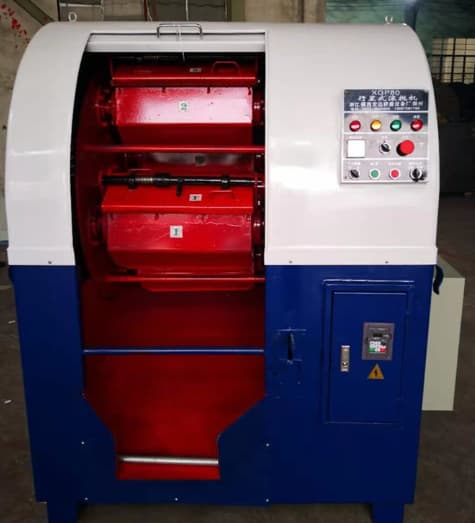
After drying, the surgical needles enter the Centrifugal Grinding Process.
This finishing operation is designed to improve both the appearance and surface quality of the needles.
Using centrifugal force, the needles are processed together with grinding media to remove small burrs created during previous machining operations while simultaneously producing a brighter and smoother surface.
According to the manufacturing process, the Centrifugal Grinder performs three primary functions:
- Brightening
- Chamfering
- Deburring
Removing microscopic burrs is particularly important because even very small surface imperfections may influence tissue penetration or product appearance.
A smooth and uniform surface also contributes to lower friction during surgery and improves the overall quality of the finished needle.
Advantages of Centrifugal Grinding
- Removes machining burrs
- Improves surface smoothness
- Produces a brighter appearance
- Enhances product consistency
- Prepares the needle for the final forming process
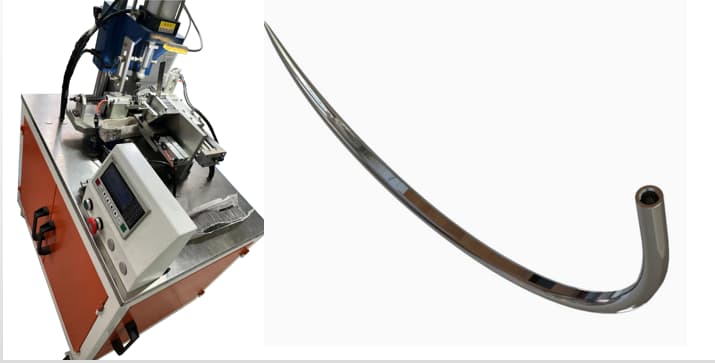
Step 14 – Angle Making Process
After surface finishing, the needle enters the Angle Making Process.
The purpose of this operation is to bend the straight needle into its specified curvature according to the product design.
Different surgical procedures require different needle shapes. Depending on the application, manufacturers may produce straight needles, 1/4 circle, 3/8 circle, 1/2 circle, 5/8 circle, or other specialized configurations.
The Angle Making Machine forms each needle with high precision while maintaining excellent dimensional consistency throughout production.
Accurate curvature is essential because it directly influences how surgeons manipulate the needle within different surgical fields.
Why Is Angle Making Important?
Proper needle curvature provides:
- Better surgical accessibility
- Improved handling performance
- Consistent needle geometry
- Stable product quality
- Compatibility with different surgical procedures
Production Capacity
Approximately 15–22 pieces per minute
Step 15 – Final Cleaning Process
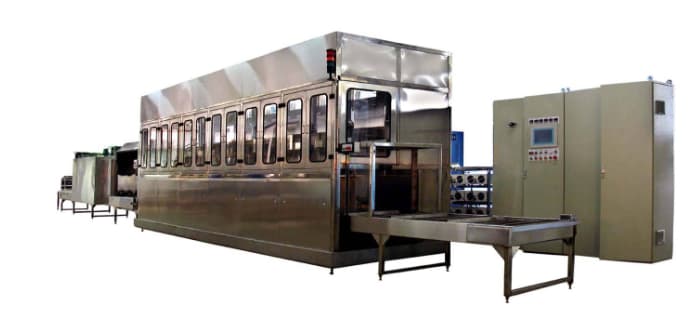
After all machining and forming operations have been completed, the surgical needles undergo the Final Cleaning Process.
Throughout manufacturing, microscopic particles, grinding residues, and processing contaminants may accumulate on the needle surface. Before the finished needles can proceed to the final surface treatment, these contaminants must be completely removed.
The Cleaning Machine and Oven thoroughly clean every needle and subsequently dry the products to ensure that the surfaces remain clean and free from residual moisture.
Final cleaning is an important preparation step before silicone coating because it allows the coating to be applied uniformly across the entire needle surface.
Objectives of Final Cleaning
- Remove residual particles
- Eliminate contaminants
- Produce a clean needle surface
- Prepare for silicone coating
- Improve final product quality
Step 16 – Silicone Coating Process
The final manufacturing operation is the Silicone Coating Process.
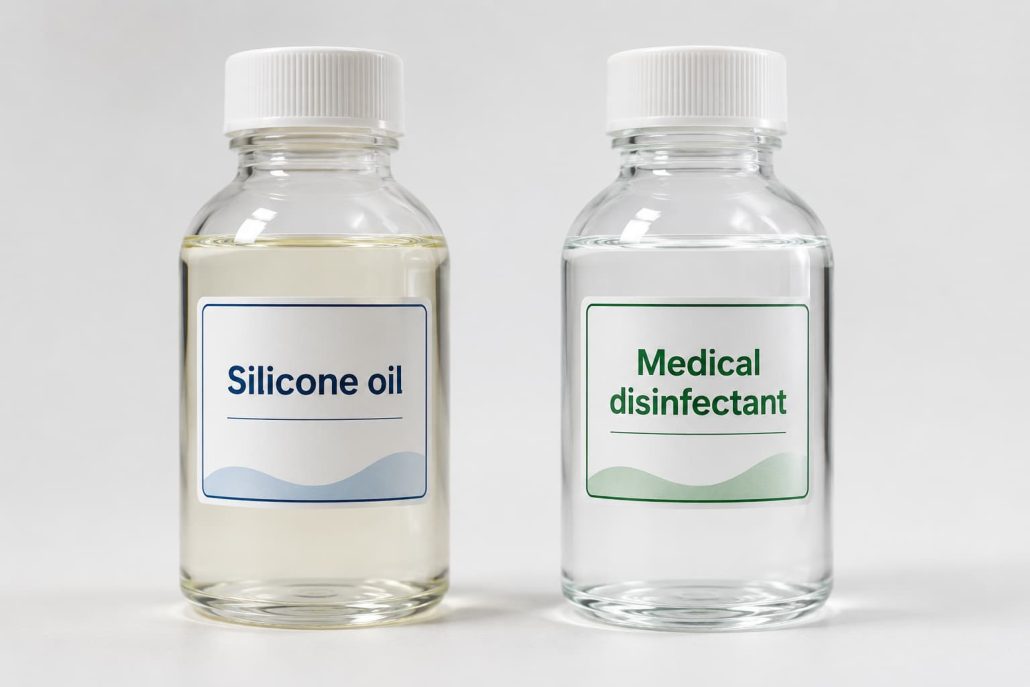
A thin, uniform layer of medical-grade silicone oil is applied to the surface of each surgical needle.
Although this coating is nearly invisible, it has a significant influence on the clinical performance of the finished product.
Silicone lubrication reduces friction between the needle and biological tissue, allowing smoother penetration while minimizing tissue trauma. It also improves the tactile feedback experienced by surgeons during suturing.
Uniform coating thickness is carefully controlled to ensure consistent performance across every production batch.
Once silicone coating has been completed, the manufacturing process of the surgical suture needle is finished, and the needles are ready for subsequent suture attachment and final packaging according to customer requirements.
Benefits of Silicone Coating
- Reduces tissue penetration resistance
- Improves insertion smoothness
- Minimizes tissue trauma
- Enhances surgical handling
- Improves product consistency
At This Stage, the Surgical Needle Is Complete
After completing these sixteen manufacturing processes, the stainless steel material has been transformed into a precision surgical suture needle with the required geometry, hardness, toughness, surface finish, and penetration performance.
Each manufacturing stage contributes to the overall quality of the final product, and together they ensure that every surgical needle meets the demanding requirements of modern medical procedures.
Lorem ipsum dolor sit amet, consectetuer adipiscing elit, sed diam nonummy nibh euismod tincidunt ut laoreet dolore magna aliquam erat volutpat.
Quality Control Throughout Surgical Suture Needle Manufacturing
Producing high-quality surgical suture needles requires much more than precision machinery. Every manufacturing stage must be supported by a comprehensive quality control system to ensure that each needle meets strict medical manufacturing standards.
Unlike many industrial components, surgical needles are used directly in clinical procedures where reliability and consistency are critical. For this reason, manufacturers continuously monitor product quality throughout the entire production process rather than relying solely on final inspection.
Quality control begins with incoming raw material inspection and continues through machining, heat treatment, forming, surface finishing, and final preparation before the needles are attached to sutures or packaged.
The following characteristics are typically monitored during production.
Raw Material Verification
The manufacturing process begins with qualified stainless steel.
Before production starts, manufacturers verify that the incoming material satisfies the required specifications for dimensions, surface quality, and material consistency.
Stable raw materials provide the foundation for stable production.
Dimensional Accuracy
Every surgical needle must maintain precise dimensions.
Manufacturers routinely verify characteristics such as:
- Needle length
- Needle diameter
- Straightness
- Overall geometry
Maintaining dimensional consistency ensures compatibility with surgical procedures and reduces variation between production batches.
Hole Position and Hole Quality
The eye of the needle is one of the most important functional features.
During production, manufacturers verify:
- Hole position
- Hole diameter
- Hole depth
- Hole symmetry
- Surface finish inside the hole
Accurate hole machining helps ensure reliable suture attachment while maintaining the mechanical strength of the needle.
Tip Geometry
The needle tip directly influences penetration performance.
Manufacturers monitor:
- Tip symmetry
- Point geometry
- Surface finish
- Machining consistency
Maintaining uniform tip geometry helps reduce tissue trauma while providing surgeons with consistent penetration performance.
Heat Treatment Verification
After quenching and tempering, manufacturers verify that the mechanical properties meet production requirements.
Typical inspection items include:
- Hardness
- Toughness
- Process consistency
Consistent heat treatment helps prevent bending, cracking, or premature failure during clinical use.
Curvature Inspection
Following the Angle Making Process, the curvature of each needle must conform to the specified product design.
Manufacturers inspect:
- Needle curvature
- Radius consistency
- Forming accuracy
Accurate curvature ensures that the needle performs as intended during different surgical procedures.
Surface Finish Inspection
Following centrifugal grinding, cleaning, and silicone coating, manufacturers verify the overall surface quality.
Inspection typically focuses on:
- Surface smoothness
- Burr removal
- Surface cleanliness
- Coating uniformity
- Overall appearance
A smooth and consistent surface improves both product quality and the surgeon’s experience during tissue penetration.
Process Consistency
Modern surgical needle manufacturing emphasizes consistency as much as precision.
Rather than evaluating only finished products, manufacturers continuously monitor each manufacturing process to reduce variation, improve production stability, and maintain high product quality over long production runs.
This systematic approach enables manufacturers to achieve consistent quality while supporting efficient large-scale production.
Common Challenges in Surgical Suture Needle Manufacturing
Although surgical needles appear to be relatively simple products, manufacturing them consistently at medical-grade quality is a highly demanding engineering task.
Each production stage introduces technical challenges that require precise process control, experienced engineering, and reliable manufacturing equipment.
Maintaining Dimensional Consistency
One of the greatest challenges is producing thousands—or even millions—of needles with identical dimensions.
Even small deviations in length, diameter, or curvature can affect surgical performance.
Manufacturers therefore rely on precision tooling and stable production processes to maintain consistent product quality.
Achieving the Correct Balance Between Hardness and Toughness
Heat treatment is one of the most technically demanding stages of production.
If the needle is too hard, it may fracture during surgery.
If it is too soft, it may bend while penetrating tissue.
Finding the correct balance between hardness and toughness requires carefully controlled quenching and tempering processes.
Producing a Consistent Needle Point
The sharpness and geometry of the needle point directly influence tissue penetration.
Maintaining consistent tip quality throughout high-volume production requires stable machining conditions and precise process control.
Even minor variations in tip geometry may be noticeable to surgeons during clinical use.
Precision Hole Machining
The needle eye must be accurately positioned and machined without weakening the needle body.
Maintaining precise hole dimensions while preserving structural integrity is one of the most challenging machining operations in the production process.
Surface Quality
Surface finish influences both product appearance and clinical performance.
Manufacturers must remove burrs, machining marks, and contaminants while maintaining dimensional accuracy throughout the finishing processes.
A high-quality surface also improves silicone coating performance and reduces friction during surgery.
High-Volume Production with Stable Quality
Modern medical device manufacturers often operate around the clock to satisfy global demand.
Producing large quantities of surgical needles while maintaining identical quality requires a combination of:
- Precision equipment
- Stable manufacturing processes
- Skilled engineering
- Effective quality management
- Continuous process optimization
Achieving this level of consistency is one of the defining characteristics of a modern surgical needle manufacturing facility.
Complete Turnkey Surgical Suture Needle Factory Solution
Establishing a surgical suture needle manufacturing facility involves far more than purchasing individual machines.
A successful factory requires careful planning of production capacity, process flow, equipment selection, technical support, operator training, and future expansion.
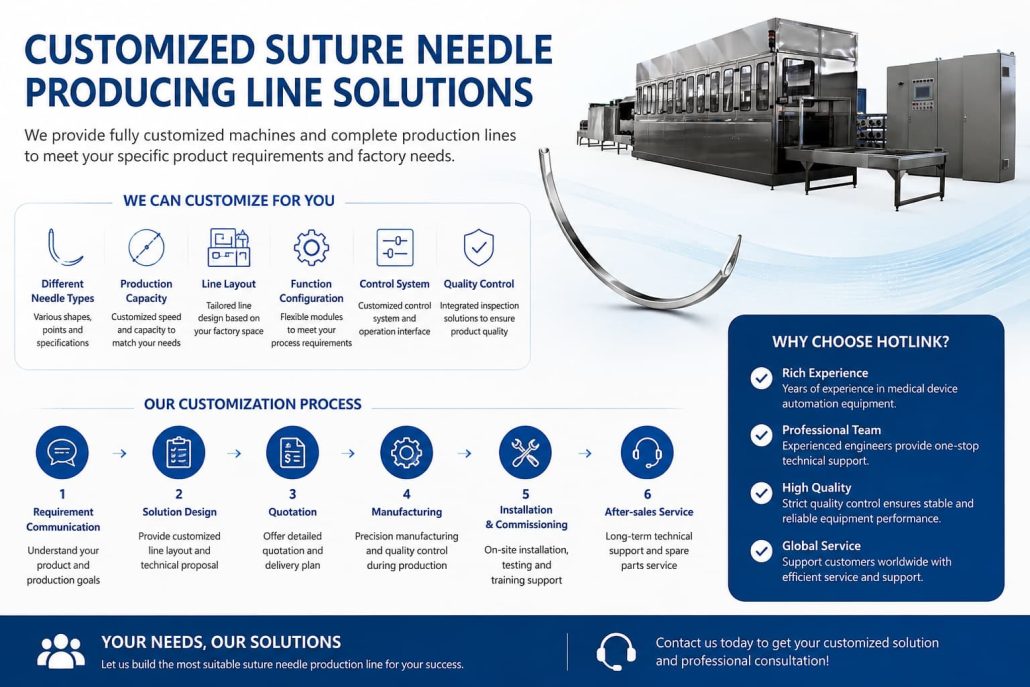
At Changzhou Hotlink Electronics Co., Ltd., we provide complete turnkey solutions for surgical suture needle manufacturing, helping customers move efficiently from project planning to stable mass production.
Our solutions can include:
- Complete surgical suture needle production lines
- Individual manufacturing machines for each production stage
- Factory layout and production planning
- Technical consultation and process optimization
- Equipment installation and commissioning
- Operator training
- Production support
- After-sales service and technical assistance
Whether customers are building a new factory or expanding an existing production facility, our engineering team works closely with them to develop manufacturing solutions tailored to their production goals and product requirements.
With years of experience in custom automation and medical manufacturing equipment, Hotlink is committed to delivering reliable, efficient, and scalable production solutions for the global medical device industry.
Frequently Asked Questions (FAQ)
1. What materials are commonly used to manufacture surgical suture needles?
Surgical suture needles are typically manufactured from high-quality medical-grade stainless steel, such as SS420J2, SS302, and SS304. These materials offer an excellent combination of hardness, toughness, corrosion resistance, and machining performance, making them suitable for demanding surgical applications.
2. Why is heat treatment important in surgical needle manufacturing?
Heat treatment is essential because it determines the mechanical properties of the needle.
The combination of quenching and tempering increases hardness while maintaining sufficient toughness, ensuring that the needle can penetrate tissue efficiently without bending or breaking during surgery.
3. Why is the needle eye so important?
The needle eye connects the suture to the needle.
Its position, diameter, depth, and surface quality directly influence:
- Suture retention strength
- Needle strength
- Manufacturing consistency
- Clinical reliability
Precision hole positioning and hole making are therefore among the most important manufacturing processes.
4. Why is silicone coating applied to surgical needles?
Medical-grade silicone oil reduces friction between the needle and tissue.
Its benefits include:
- Smoother tissue penetration
- Reduced insertion force
- Less tissue trauma
- Improved surgical handling
- More consistent product performance
5. What is the most difficult step in manufacturing a surgical suture needle?
There is no single most difficult process. Instead, manufacturers must achieve high precision throughout the entire production line.
Among the most technically demanding operations are:
- Hole positioning
- Hole making
- Tip sharpening
- Heat treatment
- Needle curving
Each process directly affects the quality and performance of the finished needle.
6. Can one production line manufacture different needle sizes?
Yes.
By changing tooling and adjusting machine parameters, a production line can manufacture different needle specifications while maintaining stable product quality and production efficiency.
7. Why is surface finishing important?
A smooth surface reduces tissue resistance during penetration and improves the overall quality of the finished needle.
Surface finishing also removes burrs and prepares the needle for uniform silicone coating.
8. How is product quality maintained during mass production?
Quality is maintained through continuous process control, including inspections of:
- Raw materials
- Dimensions
- Hole position
- Tip geometry
- Heat treatment
- Curvature
- Surface finish
Monitoring these characteristics throughout production helps ensure consistent quality across large manufacturing volumes.
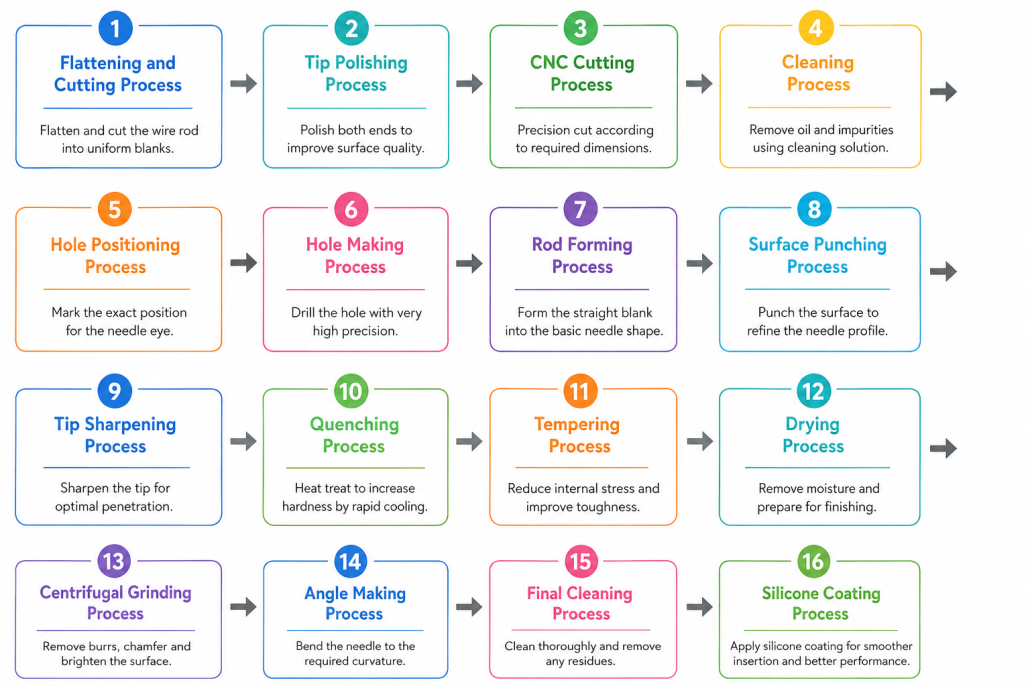
9. What equipment is required to manufacture surgical suture needles?
A complete production line typically includes equipment for:
- Flattening and Cutting
- Tip Polishing
- CNC Cutting
- Cleaning
- Hole Positioning
- Hole Making
- Rod Forming
- Surface Punching
- Tip Sharpening
- Quenching
- Tempering
- Drying
- Centrifugal Grinding
- Angle Making
- Final Cleaning
- Silicone Coating
These processes work together to produce surgical needles that meet modern medical manufacturing requirements.
10. Can Hotlink provide a complete turnkey solution?
Yes.
Changzhou Hotlink Electronics Co., Ltd. provides complete turnkey solutions for surgical suture needle manufacturing, including equipment selection, factory planning, production line integration, installation, commissioning, technical training, and after-sales support.
Conclusion
Manufacturing a surgical suture needle is a highly specialized process that combines precision engineering, advanced manufacturing technology, and rigorous quality control. From the selection of medical-grade stainless steel to the final silicone coating, every stage contributes to the performance, reliability, and consistency of the finished product.
As the medical device industry continues to demand higher quality, greater production efficiency, and improved manufacturing consistency, automated production lines have become the preferred solution for modern surgical needle manufacturers. Automation not only increases productivity but also reduces process variation, enhances product quality, and supports long-term manufacturing stability.
At Changzhou Hotlink Electronics Co., Ltd., we specialize in designing and manufacturing customized automation equipment for the medical industry. With extensive experience in surgical suture needle production, we provide complete solutions ranging from individual machines to fully integrated turnkey production lines.
Whether you are planning a new surgical needle manufacturing facility, expanding your existing production capacity, or upgrading to a more automated production system, our engineering team can help you develop a solution tailored to your technical requirements and business goals.
If you would like to learn more about our surgical suture needle manufacturing equipment or discuss your project, please contact our team. We look forward to helping you build a more efficient, reliable, and competitive manufacturing operation.