
How Disposable Syringe Needles Are Manufactured: Complete Production Process from Stainless Steel Pipe to Finished Needle
Introduction
Disposable syringe needles are among the most widely used medical consumables in modern healthcare. They are indispensable for vaccinations, blood collection, insulin injections, intravenous therapy, local anesthesia, and countless other clinical procedures performed every day around the world.
According to the World Health Organization (WHO), billions of disposable syringe needles are consumed annually, placing increasingly stringent demands on manufacturing quality, production efficiency, and product consistency. Every needle must satisfy rigorous standards for dimensional accuracy, cleanliness, sharpness, corrosion resistance, and mechanical strength before it can be used safely in medical applications.
Although a disposable syringe needle appears to be a simple stainless steel tube, manufacturing a medical-grade needle is a highly controlled industrial process involving multiple precision operations. From raw material inspection and tube preparation to cleaning, grinding, drying, and final inspection, each manufacturing stage contributes directly to the quality and performance of the finished product.
Modern manufacturers are also moving toward higher levels of automation. Automated production lines improve productivity, reduce labor dependence, minimize process variation, and help manufacturers maintain consistent product quality during large-scale production.
In this article, we introduce the complete manufacturing process of disposable syringe needles based on an actual production line. Rather than discussing only the finished product, we explain each manufacturing stage in sequence—from stainless steel pipe inspection to the final manual inspection—providing a clear understanding of how medical syringe needles are produced.

What Is a Disposable Syringe Needle?
A disposable syringe needle is a sterile, single-use medical device designed to deliver medication into the body or withdraw fluids such as blood. It is intended for one-time use only, helping reduce the risk of cross-contamination and infection.
Disposable syringe needles are widely used in:
- Vaccination programs
- Blood collection
- Intramuscular injections
- Intravenous therapy
- Insulin administration
- Local anesthesia
- Laboratory sampling
- Emergency medicine
Because these products come into direct contact with patients, every stage of manufacturing must be carefully controlled to ensure safety, reliability, and consistent clinical performance.
Basic Structure of a Syringe Needle
Although syringe needles are available in many gauges and lengths, their basic construction is similar.
Stainless Steel Needle Tube
The needle tube forms the main body of the syringe needle. It determines:
- Mechanical strength
- Corrosion resistance
- Dimensional accuracy
- Surface quality
Medical-grade stainless steel tubing is selected because it combines excellent strength with good corrosion resistance and excellent machinability.
Needle Point
The needle tip is produced through precision grinding.
Its geometry directly affects:
- Penetration force
- Patient comfort
- Clinical performance
Producing a consistent needle point is one of the most critical manufacturing processes.
Needle Hub
After the stainless steel tube has been manufactured and inspected, it is assembled with a plastic hub to create the finished disposable syringe needle.
Although this article focuses on the production of the stainless steel needle tube, this component has the greatest influence on the final product’s quality.
Raw Material Preparation
The manufacturing process begins with high-quality stainless steel tubing.
Before entering production, the tubing must meet strict specifications regarding:
- Outside diameter
- Wall thickness
- Surface finish
- Straightness
- Material consistency
Only qualified tubing proceeds to the manufacturing process.
Maintaining stable raw material quality is essential because any variation may influence cutting accuracy, grinding quality, and the consistency of subsequent manufacturing processes.
Complete Manufacturing Process
The manufacturing process described below follows the actual production workflow used in the syringe needle production line shown in the PPT. Each step plays a specific role in producing high-quality disposable syringe needles.
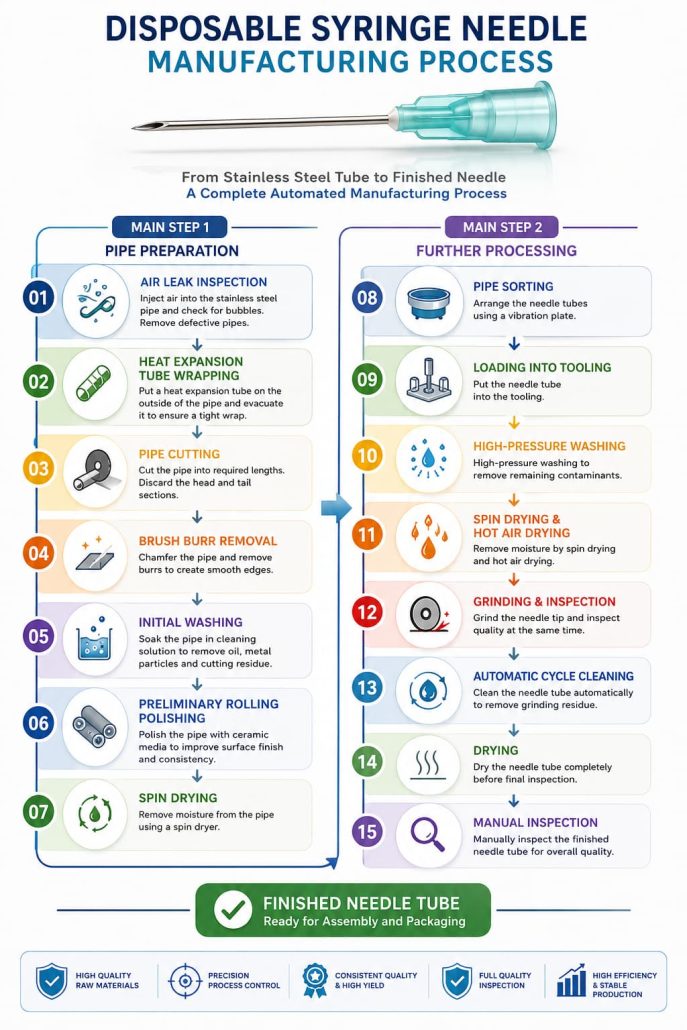
Main Step 1 – Pipe Preparation
The first stage of production focuses on preparing the stainless steel tube for subsequent precision processing. During this stage, the material is inspected, cut, cleaned, polished, and dried to ensure that only qualified tubes continue to the next manufacturing stage.
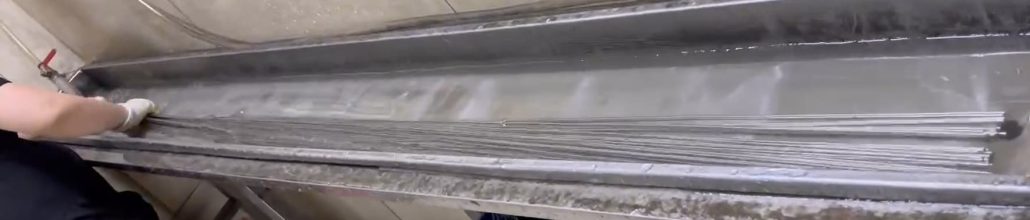
Step 1 – Air Leak Inspection
The first manufacturing step is the inspection of stainless steel tubes for leakage.
Compressed air is introduced into the tube while the tube is submerged in water.
Operators carefully observe whether bubbles appear on the tube surface.
If bubbles are detected, the tube is considered defective and is removed from production immediately.
This inspection helps eliminate damaged tubing before further processing begins, reducing material waste and improving overall production quality.
Step 2 – Heat Expansion Tube Wrapping
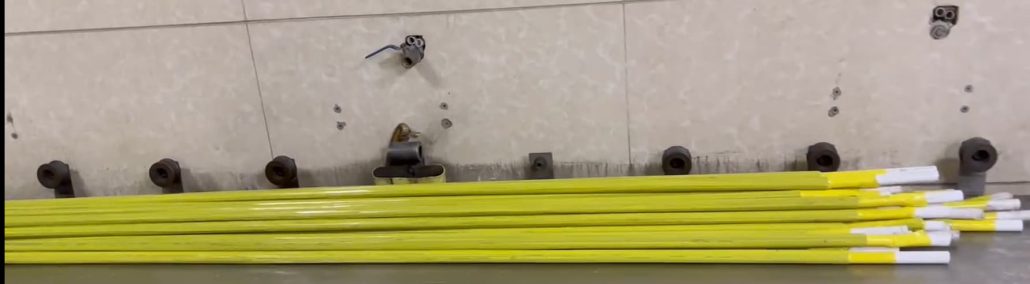
Following the leak inspection, a heat expansion tube is placed around the stainless steel tube.
Vacuum is then applied to ensure that the expansion tube tightly wraps the pipe without movement.
Proper wrapping improves positioning stability during subsequent manufacturing operations and helps maintain consistent processing conditions.
Step 3 – Pipe Cutting
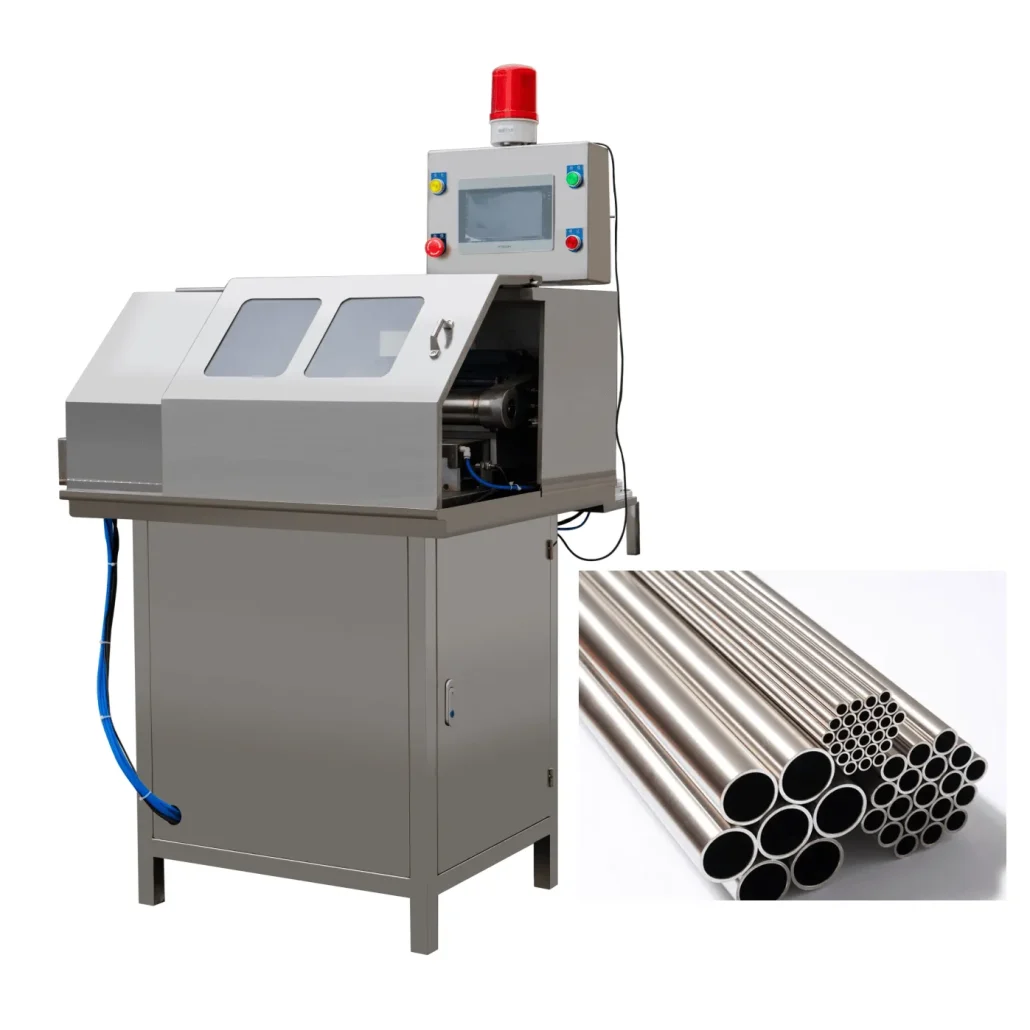
The stainless steel tube is transferred to the pipe cutting process.
According to the required needle specifications, the tube is cut into individual lengths.
During this operation, the material located at both the head and tail of the original tube is discarded to maintain consistent product quality.
Accurate cutting is essential because it directly influences the dimensional consistency of every syringe needle produced.
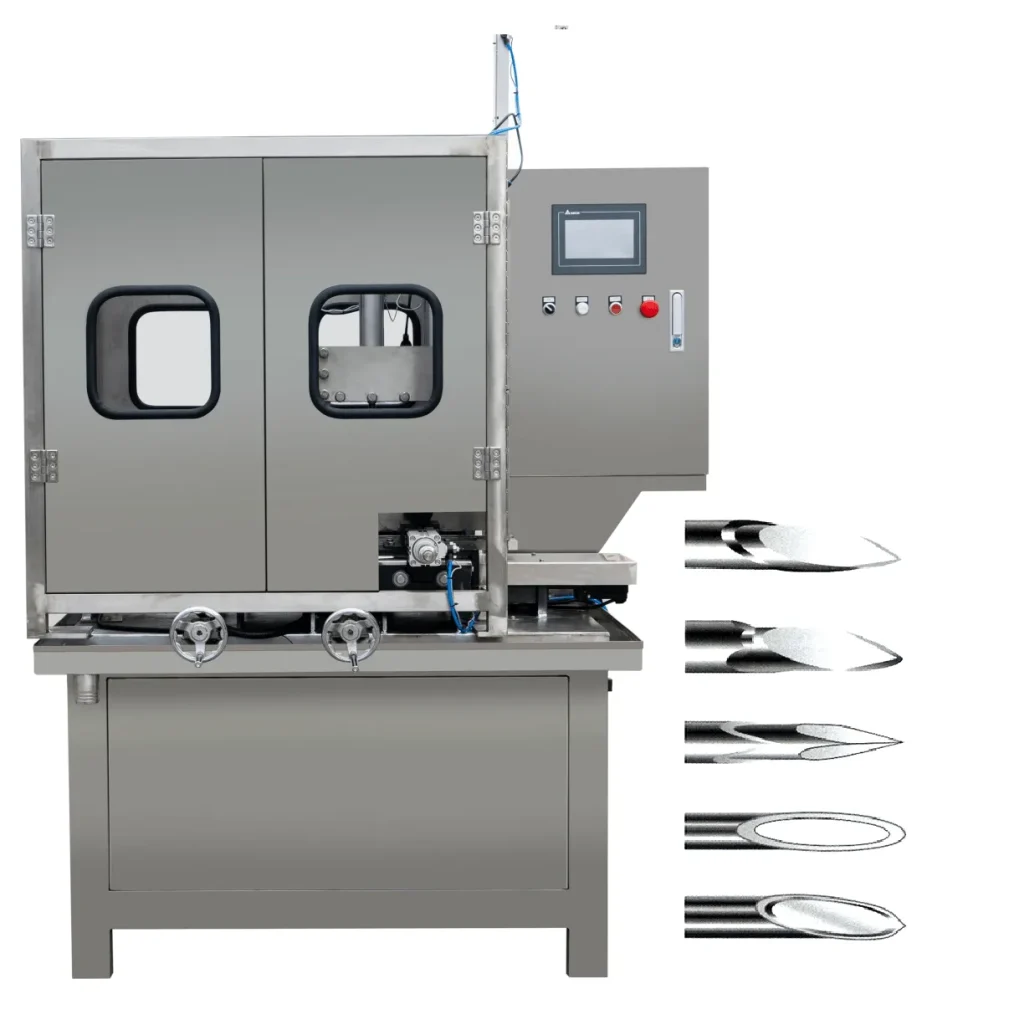
Step 4 – Brush Burr Removal
After the stainless steel tube has been cut into the required lengths, burrs remain on both ends of the tube. These burrs are a natural result of the cutting process and must be removed before further manufacturing.
During this step, the tube undergoes a chamfering process to smooth both ends while removing any remaining burrs.
Proper deburring provides several important benefits:
- Improves edge quality
- Reduces metal particles
- Prevents damage during subsequent processing
- Creates a smoother tube surface
Although this operation appears relatively simple, it plays an important role in improving the overall consistency of the production process.
Step 5 – Initial Washing
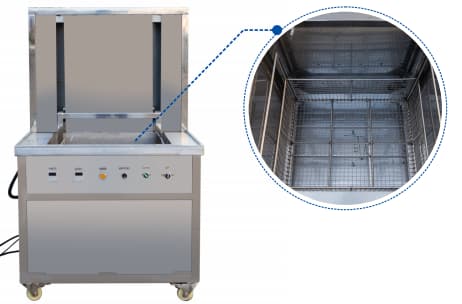
Following burr removal, the needle tubes enter the initial washing process.
During cutting and chamfering, residual cutting oil, fine metal particles, and other contaminants remain on the tube surface. These contaminants must be removed before polishing.
According to the production process, the tubes are soaked in a cleaning solution to remove:
- Surface oil
- Metal dust
- Cutting residue
- Dirt generated during machining
This cleaning stage helps improve polishing quality while preventing contaminants from affecting downstream processes.
Maintaining a clean surface also contributes to better production stability throughout the manufacturing line.
Step 6 – Preliminary Rolling Polishing
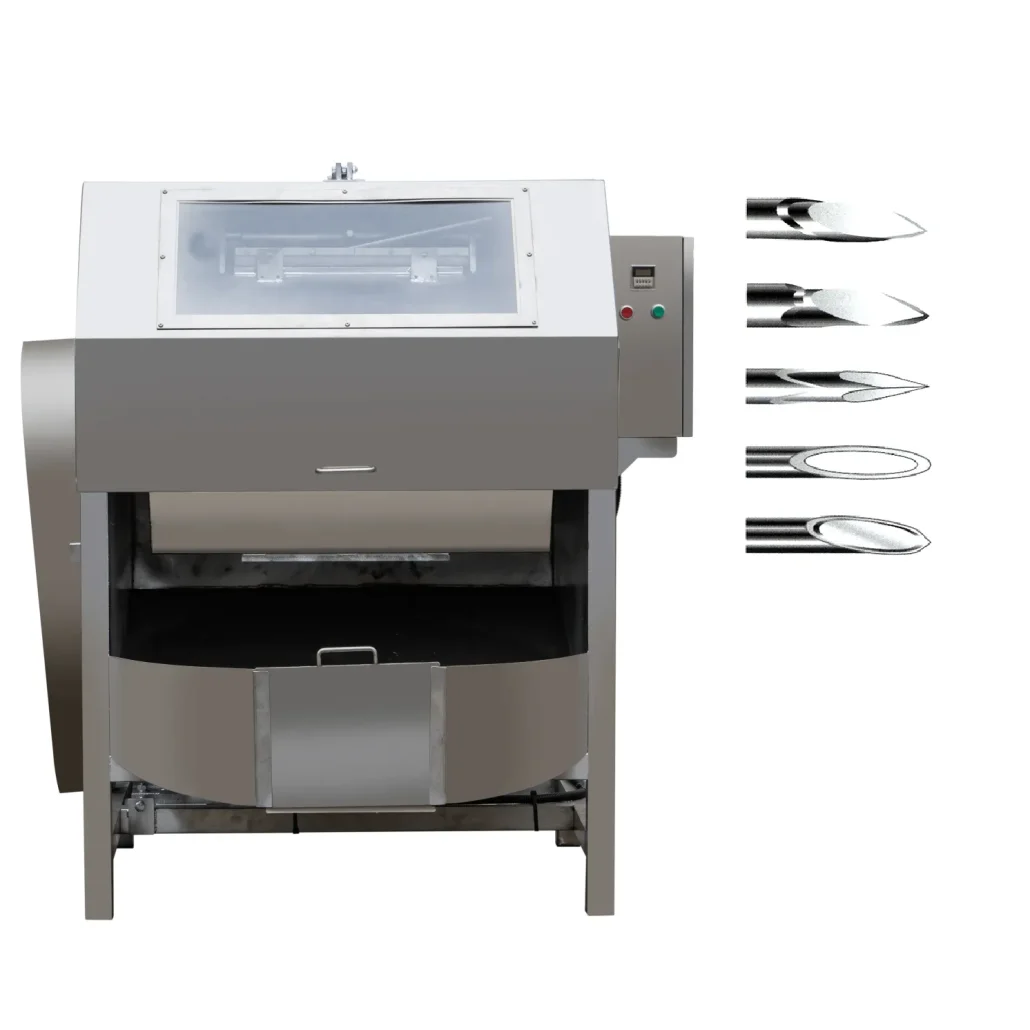
After washing, the needle tubes proceed to the preliminary polishing process.
The tubes are polished using a rolling polishing machine together with ceramic polishing media.
Unlike the final sharpening operation, this polishing process focuses on improving the overall surface quality of the stainless steel tube.
The objectives include:
- Reducing surface roughness
- Removing minor machining marks
- Improving surface consistency
- Preparing the tube for later precision processing
A smoother tube surface contributes to more stable manufacturing and better product appearance.
Step 7 – Spin Drying
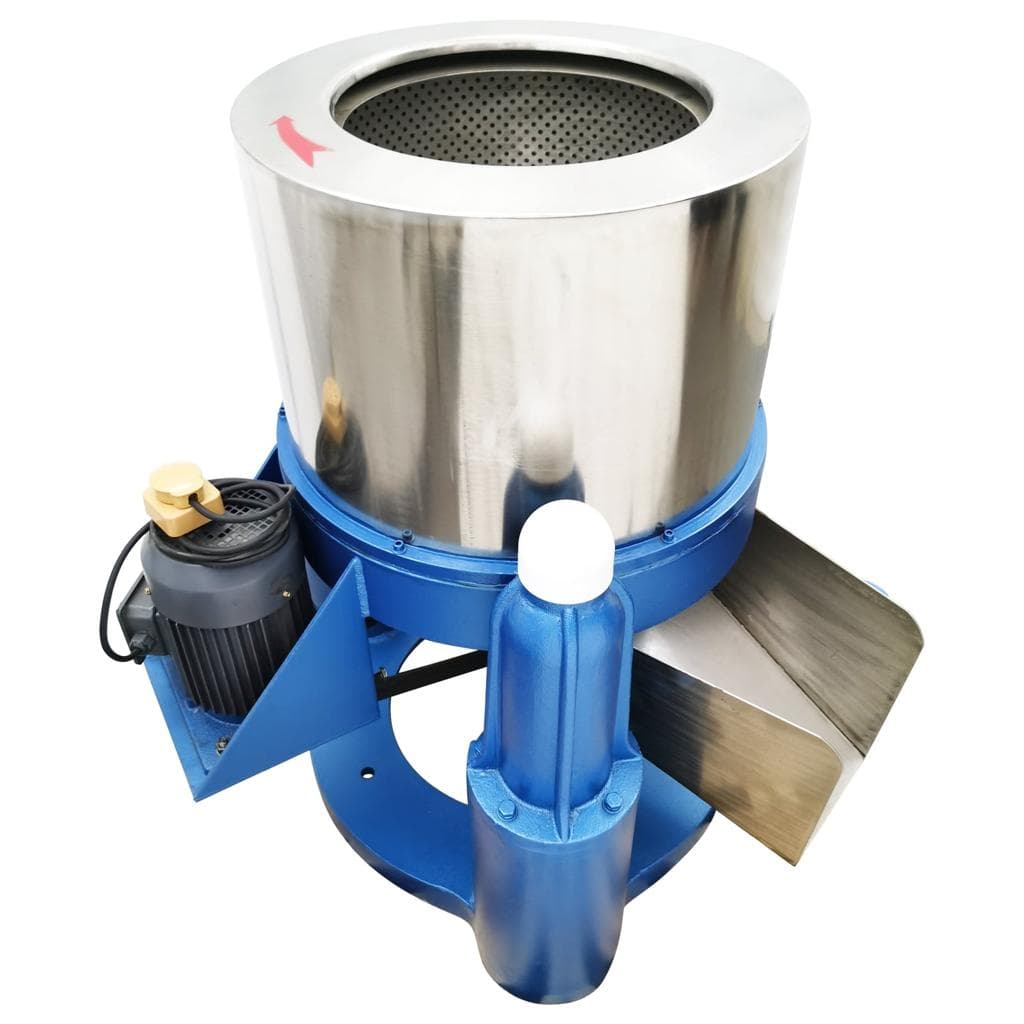
Once polishing is completed, the tubes contain residual cleaning liquid and moisture.
The tubes are transferred to a spin dryer, where centrifugal force rapidly removes water remaining on the surface.
Spin drying provides several advantages:
- Fast moisture removal
- Improved production efficiency
- Reduced drying time
- Preparation for the next production stage
Completely dried tubes help maintain process stability during subsequent operations.
Main Step 2 – Further Processing
After the pipe preparation stage has been completed, the needle tubes proceed to the second phase of manufacturing.
This stage focuses on sorting, precision cleaning, sharpening, drying, and final inspection before the finished needle tubes move to assembly or packaging.
Every operation in this stage directly influences the final quality of the disposable syringe needle.
Step 8 – Pipe Sorting
The first process in Main Step 2 is pipe sorting.
Needle tubes are automatically arranged using a vibration plate.
The vibration system aligns each tube into a uniform orientation before it enters the following production processes.
Automatic sorting provides several advantages:
- Continuous material feeding
- Stable production rhythm
- Accurate tube orientation
- Reduced manual handling
Consistent material positioning helps improve the efficiency of the entire production line.
Step 9 – Loading into Tooling
After sorting, the aligned needle tubes are transferred into dedicated tooling.
Accurate loading ensures that every tube remains securely positioned throughout the subsequent manufacturing operations.
Proper positioning helps maintain:
- Processing accuracy
- Stable transportation
- Consistent product quality
Reliable tooling is essential for achieving repeatable manufacturing results during large-scale production.
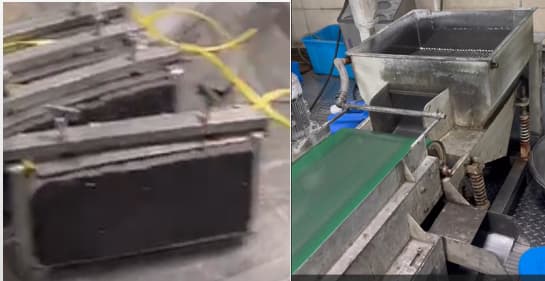
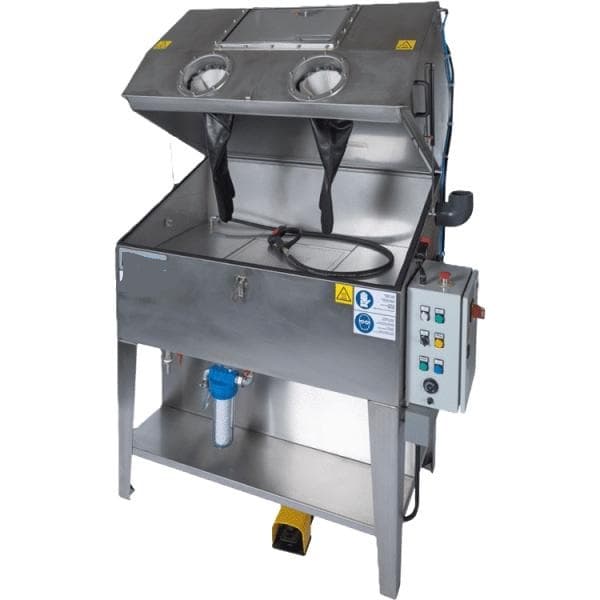
Step 10 – High-Pressure Washing
Following tube positioning, the needle tubes undergo a high-pressure washing process.
This stage removes contaminants remaining from previous manufacturing operations and prepares the tubes for sharpening.
Compared with the initial washing process, high-pressure washing provides a more intensive cleaning effect by using pressurized cleaning media to remove fine particles from both the inner and outer surfaces of the tube.
Maintaining a clean surface before sharpening helps improve machining consistency and overall product quality.
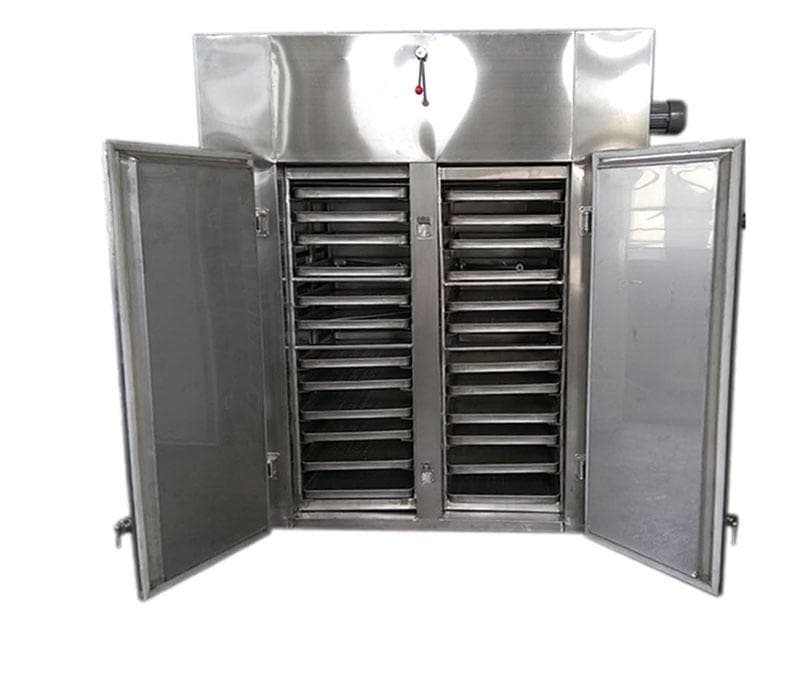
Step 11 – Spin Drying and Hot Air Drying
After high-pressure washing, the tubes must be completely dried before entering the grinding process.
The production line performs drying in two stages:
- Spin drying removes most of the surface moisture through centrifugal force.
- Hot air drying eliminates any remaining moisture to ensure the tubes are completely dry.
This combination improves drying efficiency while providing stable production conditions for the following sharpening process.
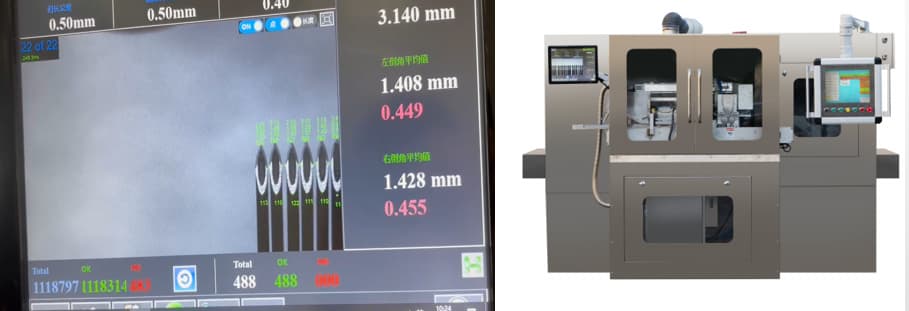
Step 12 – Grinding and Inspection
Grinding is one of the most important manufacturing operations in syringe needle production.
During this stage, the needle tip is formed through precision grinding.
At the same time, the production equipment performs an inspection process to verify the manufacturing quality.
The quality of the grinding process directly influences:
- Needle sharpness
- Penetration performance
- Product consistency
- Overall manufacturing quality
Maintaining stable grinding conditions is essential for producing high-quality disposable syringe needles.
Step 13 – Automatic Cycle Cleaning
After grinding, the needle tubes enter another cleaning process.
Grinding generates fine metal particles that must be removed before the product proceeds to the final stages of manufacturing.
Depending on production requirements, manufacturers may use either:
- An automatic cleaning machine
- A simple cleaning machine
This cleaning process removes grinding residue while improving the cleanliness of the finished needle tube.
Step 14 – Drying
Following the cleaning process, the tubes are dried once again.
Complete drying prevents residual moisture from remaining on the product surface before final inspection.
Maintaining a dry and clean product is an important requirement for subsequent assembly and packaging operations.
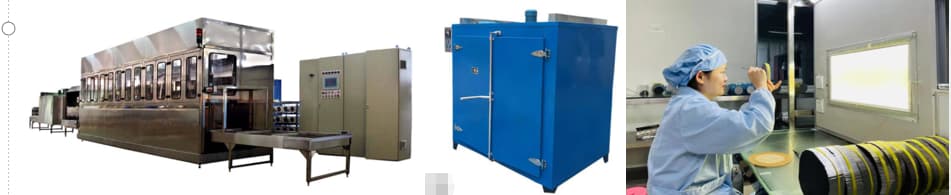
Step 15 – Manual Inspection
The final manufacturing operation is manual inspection.
Operators visually inspect every finished needle tube to verify its overall quality before it proceeds to the next stage of production.
Inspection focuses on the overall appearance and manufacturing quality of the finished product.
Only products that satisfy production requirements continue to assembly or packaging.
This final verification step helps ensure consistent product quality before the manufacturing process is completed.
Quality Control Throughout Syringe Needle Manufacturing
Producing high-quality disposable syringe needles requires more than precision equipment. Every manufacturing stage must be supported by a comprehensive quality control system to ensure that each needle tube meets the required medical manufacturing standards.
Rather than relying solely on final inspection, modern manufacturers implement quality control throughout the entire production process. This approach helps identify deviations early, reduce production waste, improve consistency, and maintain stable manufacturing performance during high-volume production.
Below are the key quality control activities integrated into the syringe needle manufacturing process.
Raw Material Inspection
Quality control begins before manufacturing starts.
Incoming stainless steel tubes are inspected to verify that they meet the required specifications for production.
Typical inspection items include:
- Outside diameter
- Wall thickness
- Tube straightness
- Surface condition
- Material consistency
Using qualified raw materials helps reduce process variation throughout the production line.
Air Leak Inspection
The first production step also serves as the first quality inspection.
By introducing compressed air into the tube and immersing it in water, defective tubes containing cracks or pinholes can be identified immediately.
Removing defective material at the beginning of production prevents unnecessary processing and improves overall manufacturing efficiency.
Cutting Quality Control
During pipe cutting, manufacturers monitor:
- Cutting length
- End-face quality
- Dimensional consistency
Maintaining consistent cutting dimensions is essential because every subsequent process depends on accurate tube length.
Surface Cleanliness Inspection
Multiple cleaning operations are included throughout the production process.
After washing, manufacturers verify that contaminants such as cutting oil, polishing residue, and metal particles have been effectively removed.
Maintaining surface cleanliness contributes to stable production quality and prepares the tubes for the following manufacturing stages.
Grinding Quality Inspection
Grinding is one of the most critical manufacturing processes.
During this stage, manufacturers monitor:
- Needle point formation
- Grinding consistency
- Surface finish
- Process stability
A consistent grinding process helps produce needle points with reliable penetration performance.
Final Manual Inspection
The final quality verification is performed through manual inspection.
Operators carefully examine the finished needle tubes to ensure they satisfy production requirements before they proceed to assembly or packaging.
This final inspection serves as the last safeguard for product quality.
Challenges in Syringe Needle Manufacturing
Although disposable syringe needles are manufactured in very large quantities, producing consistent medical-quality products presents several technical challenges.
Every manufacturing process must remain stable to ensure that millions of needle tubes can be produced with identical quality.
Maintaining Consistent Tube Dimensions
One of the biggest challenges is maintaining dimensional consistency throughout production.
Even small deviations in tube length, diameter, or positioning may influence downstream processes.
Stable equipment and precise manufacturing control help minimize dimensional variation.
Burr Removal Without Tube Damage
Removing burrs may appear simple, but excessive chamfering can affect tube geometry.
Manufacturers must carefully balance burr removal with dimensional accuracy.
Surface Cleanliness Throughout Production
The needle tube passes through several machining processes before completion.
Each process may introduce cutting oil, polishing residue, or fine metal particles.
Multiple cleaning stages are therefore essential to maintain cleanliness throughout production.
Stable Grinding Quality
The grinding process determines the geometry of the needle point.
Maintaining consistent grinding quality over long production runs requires stable equipment, reliable tooling, and controlled process parameters.
High-Speed Production with Stable Quality
Modern syringe needle manufacturers seek to maximize production efficiency without sacrificing product quality.
Achieving this balance requires:
- Reliable automation
- Stable material feeding
- Consistent process control
- Effective quality management
- Preventive equipment maintenance
Only by integrating these factors can manufacturers achieve high-volume production with consistent quality.
Complete Turnkey Syringe Needle Production Line Solution
Establishing a syringe needle manufacturing facility involves much more than purchasing individual machines.
A successful project requires careful planning of production capacity, process flow, factory layout, equipment integration, operator training, and long-term technical support.
At Changzhou Hotlink Electronics Co., Ltd., we specialize in providing complete turnkey solutions for disposable syringe needle manufacturing.
Our services include:
- Production line planning
- Customized machine design
- Factory layout design
- Equipment manufacturing
- Production line integration
- Installation and commissioning
- Operator training
- Technical consultation
- After-sales service and maintenance
Whether you are building a new manufacturing facility or expanding an existing production line, our engineering team develops customized solutions based on your production goals, product specifications, and factory requirements.
With years of experience in medical automation equipment, we are committed to helping customers improve production efficiency, reduce labor costs, and achieve stable, high-quality manufacturing.
Frequently Asked Questions (FAQ)
1. What material is commonly used for disposable syringe needles?
Disposable syringe needles are generally manufactured from medical-grade stainless steel tubing with excellent corrosion resistance, strength, and dimensional stability.
2. Why is air leak inspection performed before cutting?
Air leak inspection identifies defective tubes containing cracks or pinholes before manufacturing begins, reducing material waste and improving production efficiency.
3. Why are syringe needles cleaned several times during production?
Different manufacturing processes generate cutting oil, polishing residue, and fine metal particles. Multiple cleaning stages help maintain product cleanliness throughout production.
4. Why is polishing necessary before grinding?
Preliminary polishing improves the tube surface, removes minor imperfections, and prepares the material for precision grinding.
5. Why are both spin drying and hot air drying used?
Spin drying removes most of the surface moisture, while hot air drying eliminates the remaining moisture to ensure stable processing.
6. What is the purpose of the vibration plate?
The vibration plate automatically arranges and orients the needle tubes, enabling continuous and stable feeding into the production line.
7. Why is grinding one of the most important manufacturing processes?
Grinding forms the needle point, directly affecting penetration performance, product consistency, and overall quality.
8. Why is manual inspection still required?
Manual inspection provides a final verification of the finished product before assembly or packaging, helping ensure consistent manufacturing quality.
9. Can the production line be customized?
Yes. Production capacity, equipment configuration, factory layout, and automation level can all be customized according to customer requirements.
10. Can Hotlink provide a complete turnkey solution?
Yes. We provide complete turnkey syringe needle production line solutions, including design, manufacturing, installation, commissioning, technical training, and after-sales support.
Conclusion
Although disposable syringe needles are small medical components, their manufacturing process requires careful coordination, precision engineering, and strict quality control. Every stage—from air leak inspection and pipe cutting to grinding, cleaning, drying, and final inspection—contributes to the safety, consistency, and reliability of the finished product.
At Changzhou Hotlink Electronics Co., Ltd., we are dedicated to delivering customized automation solutions for the medical industry. Our expertise in syringe needle production lines enables us to provide everything from standalone machines to fully integrated turnkey manufacturing systems.
Whether you are establishing a new syringe needle factory or upgrading an existing production line, our experienced engineering team is ready to help you develop a solution tailored to your production needs and long-term business goals.
Types of Disposable Syringe Needles
Disposable syringe needles are available in a wide range of specifications to meet different clinical applications. Although the manufacturing process of the stainless steel needle tube is generally similar, the final product varies in needle gauge, length, bevel design, and application.
Below are some of the most common disposable syringe needle types used worldwide.
Hypodermic Needles
Hypodermic needles are the most widely used disposable needles in hospitals and clinics.
They are designed for:
- Intramuscular injections
- Subcutaneous injections
- Intravenous injections
- Drug administration
These needles are available in various gauges and lengths to accommodate different medical procedures.
Blood Collection Needles
Blood collection needles are specifically designed for venipuncture.
Compared with standard hypodermic needles, they emphasize:
- Stable penetration
- Reduced patient discomfort
- Smooth blood flow
- Consistent dimensional accuracy
These products are commonly used together with vacuum blood collection tubes.
Insulin Needles
Insulin needles are designed for diabetic patients who require frequent injections.
Typical characteristics include:
- Ultra-thin wall
- Small outside diameter
- Short needle length
- Reduced penetration force
These features improve patient comfort during repeated daily injections.
Safety Syringe Needles
Safety needles incorporate protective mechanisms that reduce accidental needlestick injuries.
Common safety features include:
- Retractable needle systems
- Protective safety shields
- Automatic locking mechanisms
These products are increasingly used in hospitals to improve occupational safety.
Dental Needles
Dental needles are used during local anesthesia in dental procedures.
Compared with conventional syringe needles, they generally require:
- Extremely sharp needle points
- Excellent flexibility
- Stable penetration performance
- High dimensional consistency
Veterinary Needles
Veterinary needles are used for animal healthcare applications.
Their dimensions vary according to animal species, ranging from small companion animals to livestock.
Needle Gauge and Length
Disposable syringe needles are available in many different sizes.
The gauge number indicates the outside diameter of the needle.
Generally,
- Higher gauge number → Smaller diameter
- Lower gauge number → Larger diameter
Common needle gauges include:
| Gauge | Typical Application |
|---|---|
| 18G | Fluid transfer, blood collection |
| 20G | Blood collection |
| 21G | General injection |
| 22G | Intramuscular injection |
| 23G | General injection |
| 24G | Pediatric use |
| 25G | Vaccination |
| 26G | Subcutaneous injection |
| 27G | Insulin injection |
| 30G–34G | Cosmetic and ophthalmic applications |
Different applications require different production tooling and process parameters while following the same manufacturing workflow.
How to Choose a Syringe Needle Production Line
Selecting the right syringe needle production line is one of the most important decisions for manufacturers planning a new factory or expanding existing production capacity.
A well-designed production line not only improves productivity but also enhances product consistency, reduces operating costs, and supports long-term business growth.
Below are several key factors to consider.
Production Capacity
The first consideration is production output.
Manufacturers should determine:
- Daily production target
- Annual production capacity
- Future expansion plans
Choosing equipment with appropriate capacity helps balance investment costs and production efficiency.
Product Specifications
Different syringe needle products require different manufacturing configurations.
Manufacturers should define:
- Needle gauges
- Needle lengths
- Product varieties
- Future product expansion
Flexible equipment can accommodate multiple specifications while reducing changeover time.
Automation Level
Automation directly influences production efficiency and labor requirements.
Production lines may include:
- Semi-automatic equipment
- Fully automatic equipment
- Robotic material handling
- Automatic inspection
- Automatic cleaning
- Automatic packaging
The appropriate automation level depends on production volume and investment objectives.
Manufacturing Consistency
Consistency is one of the most important indicators of production quality.
A high-quality production line should provide:
- Stable feeding
- Precise positioning
- Reliable process control
- Repeatable production accuracy
Stable manufacturing helps reduce product variation and improve production yield.
Quality Control Integration
Modern production lines increasingly integrate quality control throughout the manufacturing process.
Inspection systems may include:
- Tube inspection
- Process inspection
- Grinding inspection
- Final product inspection
Integrating inspection into production helps identify quality issues early and maintain consistent manufacturing standards.
Future Expansion
Medical product demand continues to grow worldwide.
When selecting a production line, manufacturers should also consider future expansion possibilities, including:
- Increased production capacity
- Additional product specifications
- Higher automation levels
- Integration with packaging lines
Planning for future development helps maximize long-term investment value.
Why Choose Changzhou Hotlink Electronics Co., Ltd.?
With years of experience in customized medical automation equipment, Changzhou Hotlink Electronics Co., Ltd. specializes in providing complete turnkey solutions for disposable syringe needle manufacturing.
Our capabilities include:
- Customized syringe needle production lines
- Standalone manufacturing machines
- Factory layout planning
- Automation integration
- Installation and commissioning
- Technical training
- After-sales support
Every production line is designed according to the customer’s product specifications, production capacity, factory layout, and long-term development strategy.
Our goal is not simply to supply machines, but to help customers build efficient, reliable, and scalable manufacturing facilities that support sustainable business growth.